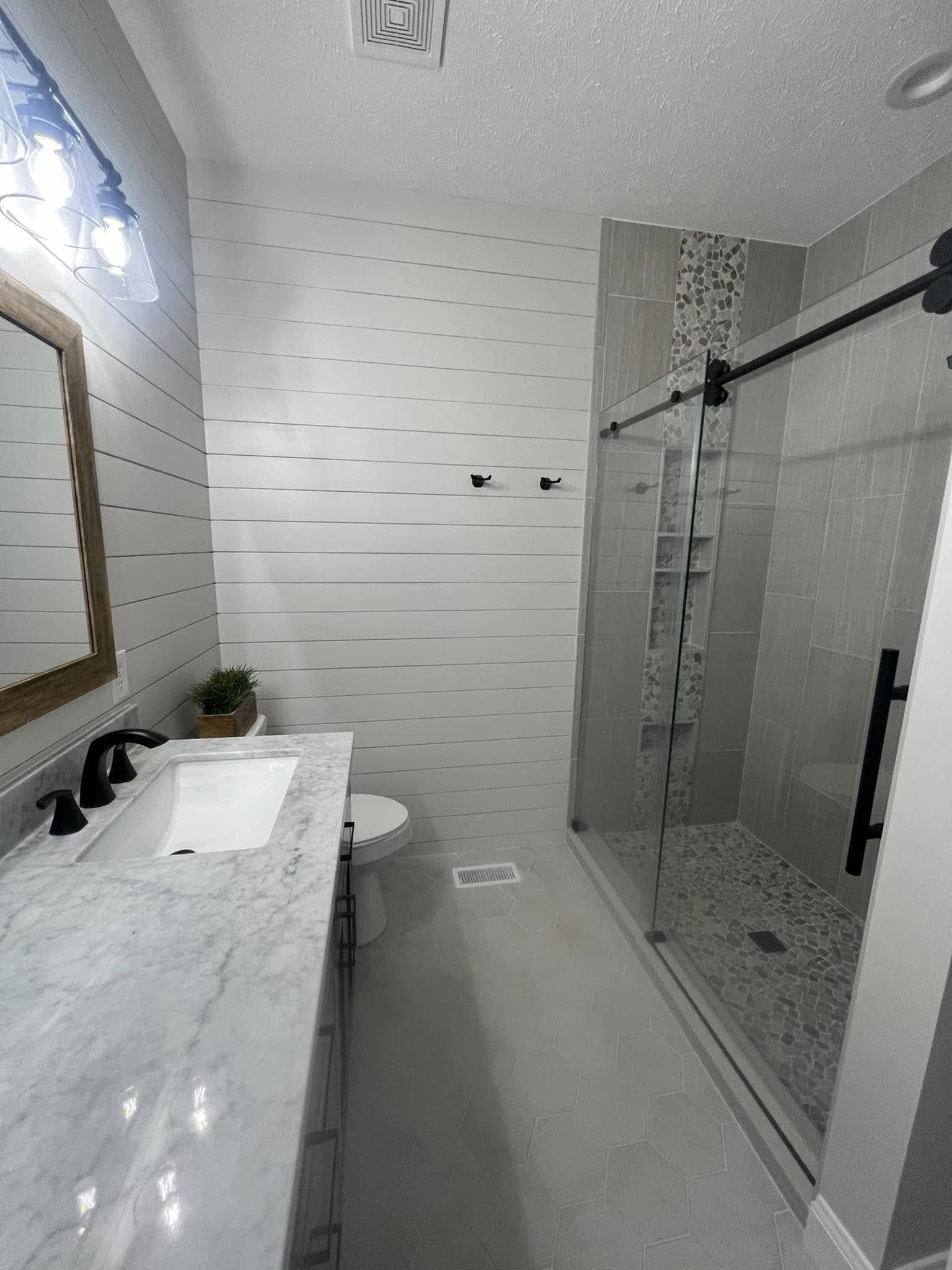
Stand in a bathroom you already own and count the metals. Faucet. Shower trim. Towel bar. Cabinet pulls. The sconce bodies beside the mirror, and the mirror frame itself. The door lever, and the hinges holding the door. The drain grate in the shower floor, the pop-up in the sink. The little trip lever on the toilet tank.
It is a longer list than anyone expects, and in most houses those pieces arrived from different suppliers across several months, each chosen on a different afternoon by somebody solving a different problem. Nobody sets out to mix metals. It accumulates, the way a junk drawer accumulates.
The rooms that look deliberate are not the ones where everything matches. They are the ones where the mixing was decided on purpose, early, and written down somewhere anyone could check.
Mixing is not the problem, drifting is
The eye is doing arithmetic whether you ask it to or not. A lead finish with a second one used on purpose reads as a pairing — somebody chose that. Keep adding, and the pattern stops resolving. What people call "too many metals" is really the absence of a rule, and the absence shows.
So the rooms that hold together have a lead metal and an accent. The lead is what you see most of, and what touches water. The accent turns up in a handful of deliberate places, often enough to read as intent rather than as leftovers.
That part is taste, and taste is yours. The rest is not: what these coatings actually are, how they wear, and which of them get settled long before you stand in a showroom.
The finish is a coating, not a metal
Almost nothing in a bathroom is solid brass or solid nickel through and through. The body is usually cast brass or zinc alloy. The color you chose sits on top of it, and how that layer was put there decides everything about how it ages.
Electroplated: chrome and brushed nickel
The part goes into a chemical bath and metal is deposited onto it electrically. Chrome is hard, chemically stubborn, and the least expensive of the common finishes to buy and to replace. It also shows every water spot, because a mirror-polished surface has nowhere to hide one.
Brushed nickel is the same process with a directional grain worked into the surface. The grain scatters light, which is why it hides spotting better than anything else in ordinary use. Its weakness is consistency: one maker's brushed nickel is cooler and grayer, another's is warm and closer to a soft gold. Two brushed nickels from two catalogs will not be the same brushed nickel, and side by side on the same wall you will see it.
PVD
Physical vapor deposition. The part goes into a vacuum chamber and a hard compound — usually titanium or zirconium based — is bonded to the surface as a vapor. It is the toughest coating in common use on plumbing fittings. It does not tarnish, it shrugs off household cleaners, and ordinary handling does not wear it through.
Most of the brushed brass, champagne bronze and satin gold on the market today is PVD. That is why it costs more, and it is also the catch: the color is locked. A PVD brass will look exactly the way it looked in the box for as long as you own it. If what you wanted was something that ages, this is the wrong coating and no amount of use will change it.
Powder coat, and most matte black
Matte black is usually a powder coat or an electrocoat — an organic layer, baked on. Done well it is durable and even. It is still, functionally, paint. It chips at an edge where a wrench slipped, abrasive pads polish it into shiny patches that never go back, and once the coating is cut the damage grows from that point.
Black is also the least standardized finish sold. Makers disagree about how black, and they disagree more about how matte. A satin black faucet beside a flat black towel bar is a visible mismatch from the doorway, and neither piece is defective. Some black is PVD now rather than powder coat, which changes the maintenance answer entirely, so ask which you are buying.
Living finishes
Unlacquered brass, true oil-rubbed bronze, weathered and antique brasses. These are meant to change, and they will.
Unlacquered brass starts bright and darkens unevenly. Hands keep the handle polished while the spout goes brown, so the faucet slowly draws a map of how your household uses it. Oil-rubbed bronze is a darkened conversion coating sealed with wax or oil, and it wears back to copper at the high points first — the tip of a lever, the edge of an escutcheon. Neither is failing. That is the finish doing what it was sold to do.
Two things follow. You have to actually want it, because the early stage is blotchy rather than antique. And a living finish will not stay related to a stable one — an unlacquered brass faucet and a PVD brass towel bar match on installation day and never again. Much of what is sold as oil-rubbed bronze now is a stable coating imitating the look, and it will never develop anything.
What the water here does to each one
Scale is the local reality. Calcium and magnesium come out of solution and dry on the surface as a deposit. It is not corrosion — nothing is eating your faucet. The finish question is only what it takes to get the deposit off, and whether the finish survives the removal.
- Chrome takes almost anything: mild acid, ordinary cleaners, a scrub. It shows scale first and forgives the cleaning entirely.
- Brushed nickel hides the film longest. Clean with the grain, not across it, and keep abrasives away from the brushed texture.
- PVD does not care what you clean it with. The scale still lands and still has to come off, but the coating underneath is indifferent.
- Powder coat is where the trouble lives. Descalers and abrasive pads are how a matte black shower head ends up patchy. It wants a damp cloth and a dry one after, which is a habit rather than a product.
- Living finishes interact with scale, and cleaning the deposit takes some patina with it. The patina comes back. That is either fine or maddening, depending on the person.
Hardware detail beats finish choice here. Silicone-nub spray faces let you rub scale off a shower head with a thumb, and an aerator that unscrews can be soaked and put back. Glass is its own conversation — untreated glass etches over time and a squeegee does more than any coating, which is worth weighing while you are choosing between framed and frameless glass.
The pieces that get decided before you shop
Several finish decisions are made weeks before anyone browses a faucet, and people find that out backwards.
Shower trim follows the valve. The handle, escutcheon, shower arm and head are trim for a specific manufacturer's rough-in cartridge sitting inside the wall. You cannot put one brand's trim on another brand's valve. That means the shower's finish family is settled at rough-in, before drywall — which is one more reason the valve behind the wall decides what the shower can do. If we are working around an existing valve, your options are whatever that maker still catalogs for it, and on an older valve that can be chrome and nothing else. Sometimes the honest answer is to replace the valve while the wall is open. We would rather have that conversation before the tile than after.
Glass hardware comes in a shorter list. Hinges, clamps, the handle, a header bar if the layout needs one. Frameless hardware is offered in fewer finishes than faucets are, and a specialty brass or a particular black may simply not exist in your glass supplier's line. Check what they stock before the faucet is ordered, not after.
The small metal gets forgotten. Shower drain grate, tub drain and overflow plate, sink pop-up, toilet trip lever, the supply stops under the vanity if they are visible. The pop-up usually ships with the faucet. The tub drain usually does not. The shower drain is chosen with the waterproofing assembly and ordered by whoever builds the pan, which is a different trade and a different purchase order, and that split is where most of the mismatches we find come from.
Anything anchored gets planned with the framing. Grab bars come in fewer finishes and need solid backing behind the drywall, so the blocking goes in while the wall is open even if the bar is years away. Choosing the bar later is easy. Adding the wood later is not.
A rule set that survives a real room
None of this is a law, and a room that breaks all of it can still look right. These are the rules we have watched survive contact with an actual house — one with a hallway attached, door hardware already on it, and a budget that ran out somewhere.
The lead metal gets everything wet
Faucet, shower trim, tub filler, drains, pop-up. One finish, and where you can manage it, one manufacturer's version of that finish. Water is where hands go and where the eye tracks, and it is the one grouping people notice when it breaks.
The accent has to repeat
A single black towel ring in an otherwise nickel room reads as a mistake. The same black on the towel ring, the cabinet pulls and the sconces reads as a scheme. Put the second finish in several places, spread so you never catch it standing alone.
Near misses do the damage, not contrast
Brushed nickel beside stainless, or two warm brasses from different makers, is what actually looks wrong — close enough to read as an attempt at matching, far enough to fail at it. Real contrast is safe. Polished chrome with unlacquered brass is legible. Brushed nickel with matte black is legible. Black is the most forgiving accent there is, because at a distance it reads as a line rather than as a metal.
Count the door, and count the hall
The bathroom door stands open more than it stands closed, so whatever the rest of the floor uses for levers and hinges is in the room whether you counted it or not. In a lot of Hamilton County houses that is builder-grade satin nickel on every hinge, and replacing hinges throughout a house is a bigger project than replacing a towel bar.
Light changes what you chose
A finish is a color, and color is a negotiation with the bulb. Warm light pushes nickel toward beige and makes brass glow. Cooler light pulls brass toward green and leaves nickel flat and gray. The same faucet under showroom lighting and in your bathroom at night is not the same faucet.
A photograph is the same trap with the light already chosen for you. The metal in a finished room is that room's bulbs and that day's window as much as it is the finish, which is why a picture is good for reading a scheme and no help at all for matching a color.
So hold samples in the actual room, on the actual wall, after dark and at midday, under the bulbs you intend to install — a good reason to settle the lighting layers before the finish order goes out. Sconce bodies matter less than people fear, sitting above eye level and often seen against their own light. The mirror frame matters more, at eye height in the middle of the wall, which is worth remembering while sizing the mirror.
Writing it down so the boxes match
A finish name is not a specification. "Matte black" is a category, not a product, in the same way that "white subway tile" is not a specification. What belongs on the estimate is the manufacturer, the model number and the finish code that hangs off the end of it, item by item.
A few habits that save trouble:
- Order the whole finish family in one purchase where you can. Production lots drift, and they drift most on black and on brass.
- Buy the spare while the finish is current. A discontinued finish is how one broken towel bar turns into replacing every piece in the room.
- Keep a physical sample of each and set them together on the vanity before the tile goes on, not after.
- Write down who is buying what. Owner-supplied fixtures are fine with us. What causes a change order is a fixture that arrives in a finish nobody recorded, on the day it was supposed to go in.
We will say plainly when a combination is going to read as an accident, and we will say just as plainly when it is a preference and not our call. The place we do insist is sequence: the shower family before the valve goes in the wall, the glass hardware confirmed before the faucet ships, the blocking in before the drywall. That ordering is the same one described on our bathroom remodeling page — strip out, then the part you never see, then finish. Finish selections belong to the first stage even though they show up in the last.
What to remember
Pick a lead metal and give it everything the water touches. Pick one accent and let it repeat. Avoid near misses, not contrast. Know whether the coating you bought is stable or living, because a living finish is a decision about the years ahead and not just about the box it came in. And settle the shower family before anyone opens a wall — that one stops being a choice the moment the valve goes in.
If you want somebody to walk your bathroom and put the finish schedule in writing alongside everything else, ask for an estimate and we will go through it in the room.