Stand in front of your bathroom mirror and look up. If the light in that room is one or two cans in the middle of the ceiling, everything reaching your face is arriving from above and behind you — so the shadows fall into your eye sockets, under your nose, under your chin. The room is not dim. It is lit from one direction, and one direction is the whole problem.
The fix is almost never a brighter fixture. It is more sources, doing different jobs, on separate switches. And nearly all of it gets settled with the walls open, at a point in the job when most people are not thinking about light at all.
What a single overhead actually does
A downlight lights the top of things. Horizontal surfaces go bright — the vanity top, the floor, your shoulders. Vertical surfaces get whatever bounces back off them. Your face is a vertical surface. So is the tile, and the front of the vanity.
That is why a bathroom with good tile and a good vanity can still read flat. Texture shows only when light crosses it at an angle, and straight down erases it. A handmade tile with a wavy face, a honed stone top, the grain in an oak door — all bought for the way they take raking light, then lit so they never get any.
There is a second problem, and it is geometric. The single can sits in the center of the ceiling, because that is where a fixture goes when nobody planned one — and the center of a bathroom is rarely above anything you use.
The three layers, and what each one is for
Ambient
Ambient is fill. It decides whether the room reads as a room or a closet, and it is the layer you switch on walking in with an armful of towels. Cans, a flush mount, light bounced off a ceiling — the type matters less than the level.
It is also where most bathrooms stop, because it is the easiest layer to add more of. If a room feels wrong, more cans give you a brighter wrong room.
Task
Task light is pointed at a place where something specific happens: the mirror, the shower, and the toilet compartment if it has a door on it.
At the mirror the job is to light a vertical plane — your face — from roughly its own height, and from both sides if the wall allows. In the shower the job is to light an enclosure built to block light. A shower with no fixture of its own is a cave, and you find that out the first time you try to tell two bottles apart in it.
Accent — the layer everyone skips
Accent light has no functional job, which is exactly why it is the first line struck when a quote has to come down. It grazes a tile wall so the texture shows. It washes the inside of a niche. It sits under a floating vanity and puts a soft edge around something your eye then reads as deliberate. It is most of what you notice in a finished room without being able to say what you are noticing.
It also does one practical thing better than either of the other layers. A low accent source — a toe-kick strip, a niche light, one small fixture at the bottom of a dimmer — makes the room usable in the middle of the night without the ceiling coming on and waking you properly. That argument survives a budget conversation. "It looks nice" does not.
Skip it and nothing is broken. The room just looks lit rather than designed, and nothing on the punch list explains why. In a bathroom your guests use and you do not that is a defensible cut. In a primary bath it is the layer people miss later.
The vanity, where most of this gets decided
Sconces beside the mirror
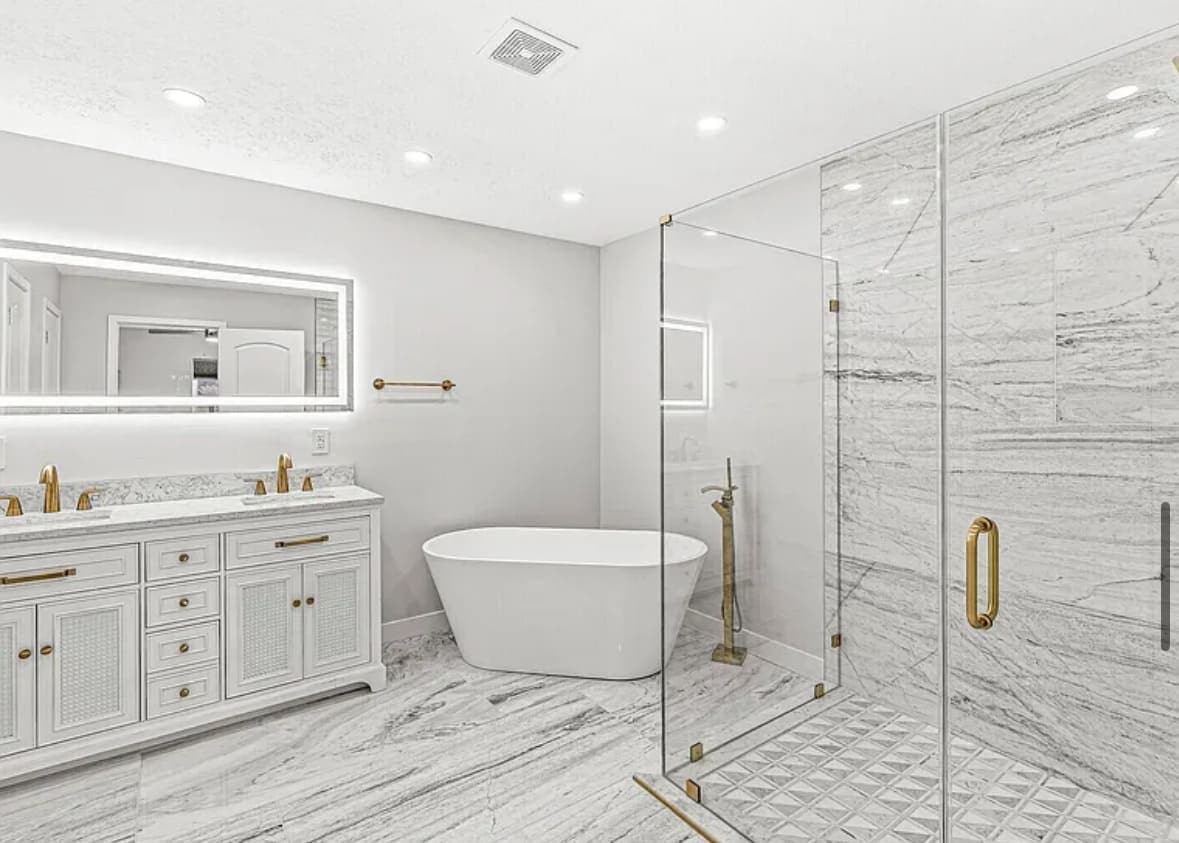
Light from either side of the glass arrives at your face horizontally, and each side fills the shadow the other one casts. Nothing else does that. Mounted near eye height, flanking the mirror, a pair of sconces is the reason a hotel bathroom flatters you and yours does not.
The constraint is wall. You need mirror width plus clear wall either side, which makes the mirror, the vanity and the sconces one decision instead of three — and one that has to land before the electrical rough-in, not when the mirror turns up. Box positions fall out of the vanity and mirror choice, which stops being a finish selection and becomes a framing one.
A bar above the mirror
Second best, and often the only option — a mirror running wall to wall, a double vanity, a wall with nothing to spare. A bar works when it is wide, diffuse, and not so high that it becomes another overhead. Bare decorative bulbs above a mirror look good switched off and put a shadow line under your brow switched on.
The lit mirror
A backlit or edge-lit mirror is a fixture, not an accessory. It wants a box behind it in a particular place, sometimes somewhere to put a driver. On a tiled wall that box has to be right before any tile goes on, because a mirror that moves later moves through tile.
Where the wiring has to be decided
Electrical rough-in happens after demolition and framing, before insulation and drywall. That is the window. Every box, every switch leg and every cable pull is fixed in it, and the cost of changing any of them climbs the day drywall goes on and again the day tile covers it.
By rough-in, these have to be answered:
- How many layers, and which switch controls which. Layers only exist if they are separately switched — three fixtures on one switch is one layer with three fixtures in it.
- Where the mirror sits, how wide and how high — that fixes the sconce boxes and the blocking behind them.
- Whether the mirror is lit, and where its supply lands.
- Whether there is a niche or shelf light. That is a penetration through the shower waterproofing, and it has to be detailed by whoever owns that layer rather than drilled through it afterwards by whoever is holding the light.
- Dimming, which needs a neutral at the switch for most modern dimmers — not a given in an older Hamilton County house, where a switch loop may have been run with no neutral in it at all.
- The fan on its own control, separate from the light, for the reason we go into in the fan post — a fan wired to the light switch gets turned off with the light, every time.
Adding a sconce later means opening a finished wall, fishing a cable, patching, priming and repainting. On a tiled wall it means taking tile off. That is one of the ordinary ways a bathroom generates a change order, and an hour of thinking at the right moment avoids it.
The scope on our bathroom remodeling page puts electrical adjustments in the strip-out stage and the fixtures themselves in the finish stage at the end. The lighting plan belongs to the first of those, not the last. By the time anyone is holding a sconce up to a wall, that wall has already decided whether there is going to be one.
Damp, wet, and the zone over the tub
Fixtures carry a listing: dry location, damp location, wet location. A dry-listed fixture in a shower is not a paperwork technicality — its housing, gasket and lens were never built for the vapor a hot shower drives into anything with a gap, and it corrodes inside the can, where you cannot see it.
Over a tub and inside a shower enclosure there is a zone where only fixtures listed for those conditions are permitted, measured out from the tub rim or the shower floor. The dimensions belong to your jurisdiction and the inspector enforcing them — confirm them with the local building department rather than with a blog. What is worth asking a contractor for is simpler than the code anyway: which fixture is listed for which location, written next to the fixture in the estimate.
What is printed on the box
Color temperature
Every lamp lists a color temperature in kelvin. Lower reads warm and yellow, higher reads neutral and white, higher still starts reading blue and clinical. There is no correct answer for a bathroom — it depends on the finishes, the window and what you do in there.
There is a wrong practice, though, and it is mixing. A warm sconce beside a neutral ceiling can, with a cooler lit mirror between them, makes your skin tone shift as you turn your head and white tile look gray where the sources overlap. Pick one temperature for the whole room and hold every fixture to it, the one in the shower included. Buy the room from a single manufacturer's series where you can — two fixtures with the same number on the box, from different makers, often do not match on the wall.
Color rendering
Color rendering describes how honestly a source shows color against daylight. It decides whether the paint you chose is the paint you see, and whether makeup matched at the mirror still matches in the car. It is the first thing cut in a cheap fixture, because nobody reads it in the aisle.
Dimming
Not every LED fixture dims, and the ones that do only dim properly with a dimmer their driver is compatible with. The failure modes are visible and they do not settle down: a flicker at the bottom of the range, a buzz you hear at night, a drop-out where the fixture goes dark well before the slider does. Manufacturers publish compatibility lists, and somebody has to read them before the fixtures are ordered. Integrated fixtures, where the chip is the fixture and there is no lamp to change, come down whole when one fails — a fair trade for a slim profile, and a bad surprise if nobody mentioned it.
What it costs, roughly
We do not publish our own prices: a number written before anyone has seen your bathroom is a guess. What we can point at is what independent research says people around here spend on a bathroom overall. Angi's Indianapolis bathroom cost research and published Greater Indianapolis contractor cost guides put a typical bathroom near $10,000, with most landing between roughly $5,700 and $14,700, and full remodels across the wider metro from about $7,500 past $25,000.
Lighting sits inside that as a small material line and a larger labor one. Fixtures are a shopping decision and can be revisited. Boxes, cable and switch legs are a construction decision, and that one closes when the drywall goes up. A rough-in that anticipates a sconce keeps the option open even if the sconce gets bought next year. A wall closed without one takes it away.
The short version
Three layers, three jobs. Ambient sets the level. Task lights your face and the inside of the shower. Accent is the one that gets skipped, and the one doing most of the work to make a room read as considered rather than merely bright. A single overhead does the first job only, from the worst available angle for the second.
Decide it early. A lighting plan is not a shopping list, it is a wiring plan, and a wiring plan is set while the studs are showing. Fixtures can change later. Boxes cannot, or not quietly.
Light is also the cheapest lever left when the rest of the plan is fixed. If the fixtures are staying where they are because the plumbing is staying put, light is most of what is left to change how the room feels.
If you want someone to walk your bathroom and mark where the boxes should go before anything comes off the wall, ask for an estimate and we will tell you which of the three layers your room is actually missing.