The deck argument almost always happens at the top. Wood or composite, board color, screws through the face or hidden clips. Meanwhile the part that decides whether the thing is still solid years from now sits under the boards, never gets looked at, and rarely comes up in a sales conversation.
Weather here does not attack a deck across its face. It attacks joints, end grain and holes. Water gets into a cut end, a screw penetration or a checked board, freezes, expands, and leaves the gap it arrived through slightly wider than it was. Then it thaws and does it again the next night. Multiply that by a Central Indiana winter, add a humid summer that keeps everything under the deck damp, and you have the mechanism. The board you choose matters. It matters less than where the water is allowed to sit.
What the weather is actually doing
Three things happen to an exterior horizontal surface here, and they happen to every material on the list.
The first is wet-dry cycling. Boards take on moisture through spring, give it back in a dry heating-season stretch, and move while they do it — the same seasonal movement that shows up indoors in hardwood and cabinet doors, except outdoors it is unrestrained and much larger. Wood shrinks across its width far more than along its length, so a board gets narrower, not shorter. Gaps you set in June are not the gaps you have in February.
The second is freezing, and the damage is in the repetition rather than the event — the same reason freeze-thaw takes exterior grout and mortar apart here. A deck is more exposed to it than anything else you own.
The third is ultraviolet light. Sun breaks down the lignin at the surface of any wood, which is why an unfinished board goes gray, and why a finish is mostly a sacrificial layer rather than a decoration. Nothing on the market is exempt from all three. What differs is which one gets you first.
Pressure-treated pine
Most decks around Fishers, Carmel and Noblesville are southern yellow pine treated with a copper-based preservative. The copper is what stops rot and insects, and it is worth understanding two things about it.
Treatment comes in ratings — above-ground and ground-contact are different products, with different amounts of preservative driven into the wood. Anything close to the dirt, anything that will stay damp under a low deck, and anything in doubt should be ground-contact material. Small upcharge on the lumber, and it is the part of a deck nobody re-does later.
The copper is also corrosive to plain steel. Fasteners and connectors have to be hot-dip galvanized or stainless, rated for use in treated lumber. Plain screws in treated pine rust from the inside of the hole outward, and the first sign is a black halo around every fastener.
Treated boards also arrive wet, straight out of a pressure cylinder and still giving up solution. Fastened tight while wet they shrink and open gaps. Fastened with a wide gap while wet they shrink into gaps you can drop a phone through. And every cut exposes untreated wood in the middle of the board, which is why end-cut preservative belongs on site with the saw.
What maintenance really means
The honest version: a treated deck needs washing and re-coating, and the interval depends on sun and on what went on it last time.
A film-forming solid stain covers the grain and looks the most finished on day one. It also sits on top of the wood, so when it fails it peels — at the stair treads, along the traffic paths, wherever the sun is hardest. Recoating over peeling film means stripping or sanding first, and that job gets worse every cycle.
A penetrating semi-transparent oil soaks in instead of building a skin. It fades rather than peels, and fading means you wash it and put more on. If you are the kind of person who gets to it eventually rather than on schedule, that is the finish to buy.
What does not work is staining a new treated deck immediately. The wood has to give up its moisture first or the finish will not penetrate. Sprinkle water on a board — if it beads and sits there, the deck is not ready.
Cedar
Western red cedar has natural extractives in its heartwood that resist decay, which means the durability is in the wood rather than in a treatment. It is dimensionally stabler than pine, so it cups and checks less, and it is much nicer to walk on barefoot because it stays cooler and it is soft.
Soft is also the drawback. Cedar dents under furniture legs and dog claws in a way pine does not. And the pale sapwood in a board does not carry the decay resistance the dark heartwood does, so what you are paying for depends on the grade that actually gets delivered.
Left alone, cedar silvers to gray. That is a legitimate choice, not neglect, and a low-maintenance path if you commit to it. What is not a plan is buying cedar for the warm red color and then not recoating — that color is a finish, it is the first thing UV takes, and keeping it means getting on the deck with a brush on a cycle. Cedar also reacts with plain steel and streaks black around fasteners, so stainless is effectively mandatory.
Composite and PVC
Composite decking is wood flour mixed with polyethylene and extruded into a board. PVC has no wood content at all. Both exist to stop the maintenance conversation, and both mostly do.
Capped, uncapped, and what actually fades
The generation of composite that gave the category a bad name was uncapped — wood flour exposed at the surface, which meant it stained, held mildew and went blotchy on the shaded side of the house. Current boards are capped: a polymer shell co-extruded over the core on the faces and edges. The cap is what does the work. It is also the reason a composite board cannot be sanded or refinished. Scratch through the cap and the repair is a new board, not a touch-up.
All of them fade some early and then settle. Dark colors get hot in full afternoon sun, hot enough to matter on a west-facing deck with no shade. And the cap resists staining, not shading — under a maple, on the north side, composite grows the same green film wood does and needs the same wash.
What composite changes under the boards
This is the part that gets left out. Composite is not structural. It spans between joists to whatever the manufacturer's span rating allows, and that rating is frequently tighter than wood decking, tighter again for a diagonal layout, and tighter again under stair treads. Choosing composite often means adding joists or blocking to the frame.
It also moves with temperature rather than with moisture, and it moves along its length — the opposite axis from wood. That is why the manufacturer gives you a gapping table keyed to the temperature on the day of installation. Butt joints installed tight on a cold morning in March will buckle in July. Follow the table, not your instinct from framing.
The maintenance saving is real. Part of the cost just moves into the frame. Any quote that swaps wood decking for composite without changing a line about the framing is worth asking about — the same way the cheapest quote is usually the one that left a stage out.
The substructure decides all of it
You can put the most expensive board on the market over a frame that will not last, and you will replace the frame first.
The ledger, and the houses where there cannot be one
Where a deck attaches to the house is where deck failures turn dangerous. The ledger has to be flashed — metal above it, tucked behind the housewrap and siding so water running down the wall goes over the top of the ledger and out, not into the joint. It has to be fastened through the rim joist with the structural fasteners and pattern the code table calls for. Nails are not a ledger connection.
And on a lot of houses around here with brick or stone veneer, there is no ledger connection at all. Veneer is a skin hung off the house, not structure, and nothing may hang off it. That deck gets its own posts and beam along the house side and stands free. If someone quotes you a ledger bolted through brick, that is the moment to stop.
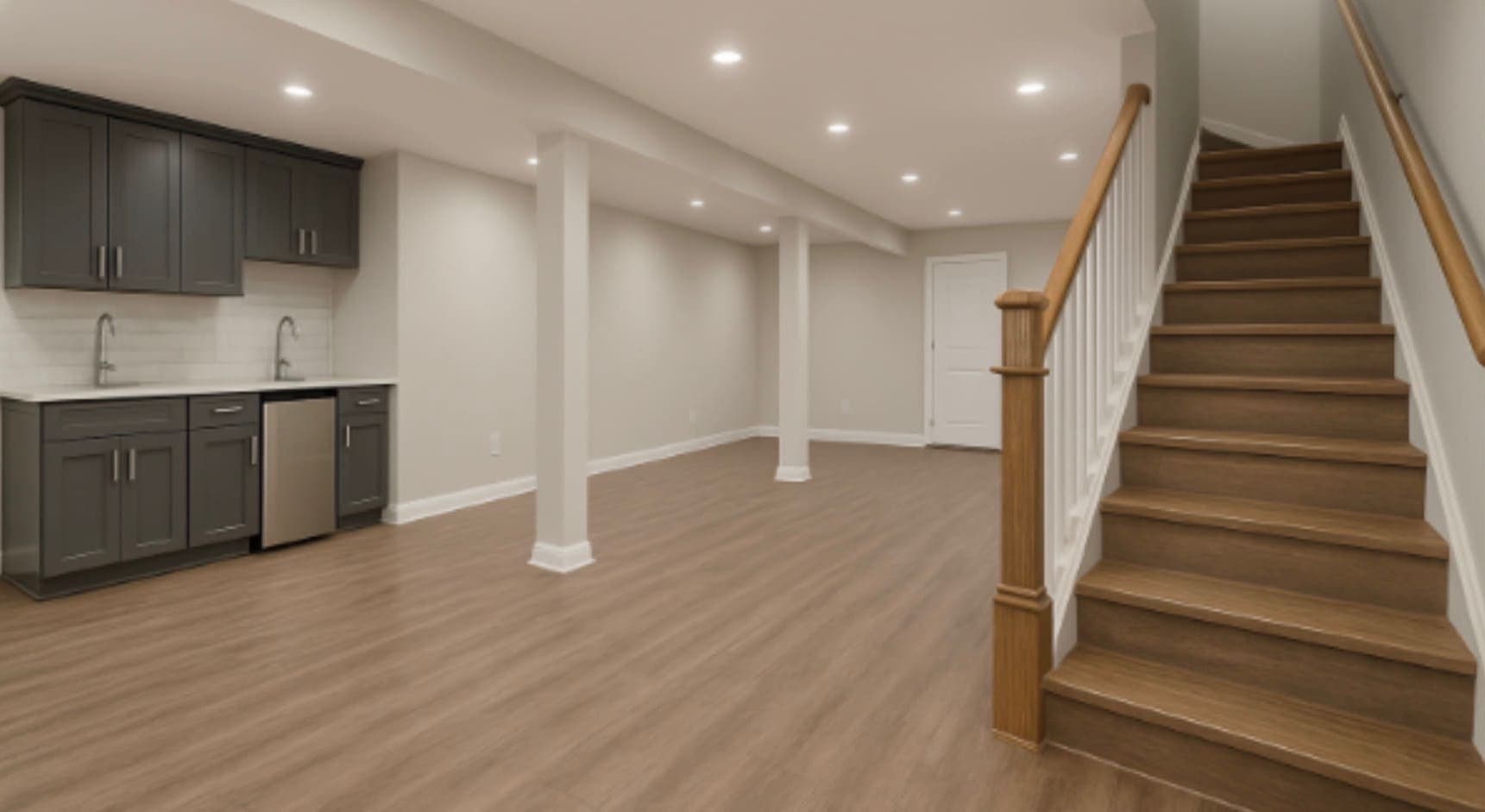
We have opened enough rim joists during basement finishing to know what an unflashed ledger does to one — a dark, soft band running along the top of the foundation wall, on the inside, directly under the best part of the back yard. Nobody finds that from outside.
The top of a joist is a flat wet surface with holes in it
Every deck screw makes a hole in the top edge of a joist, and every one of those holes fills. Butyl or acrylic joist tape run along the top of each joist and beam before the boards go down seals around the fastener as it drives. It is cheap, it goes on before the boards do, and it addresses the single most reliable place a frame starts to go. If a quote does not mention it, ask.
Post bases matter for the same reason. A post standing on concrete wicks water up its end grain, and a post set in concrete is worse — a wood core in a bucket.
Footings
Footings have to reach below the frost line, because soil that freezes under a shallow one lifts it and does not put it back where it started. In Central Indiana that depth is commonly in the range of 30 to 36 inches, but the number that governs your deck is the one your local building department gives. That whole subject, and what heave looks like when it happens, is its own post.
Permits and the neighbors
A deck is structural work and it changes the outside of the house, which puts it in front of two authorities. Fishers takes residential applications through its online permitting portal, and Carmel, Noblesville and Westfield each run their own building department — do not assume they match. What triggers a permit is covered in do you need a permit in Fishers. The second authority is the HOA, which in a lot of Hamilton County neighborhoods has opinions about railing style, board color and how far into the yard a structure may come. Check that before anything gets drawn, not after the lumber is ordered.
Choosing, honestly
There is no best material. There is a match between how the deck gets used and what you are willing to do to it.
- Full sun, dark composite — think about bare feet in August before you choose the color.
- Deep shade under trees — everything grows algae, so budget a wash either way and do not buy composite expecting to skip it.
- You will not get to maintenance — treated pine with a penetrating oil, or cedar you have decided to let go gray. Not a solid film stain.
- Low deck close to grade — ground-contact framing, drainage under it, and spend on the frame rather than the surface.
- Staying a long time — the substructure is where the money goes. The boards are the part you can change later; the frame is not.
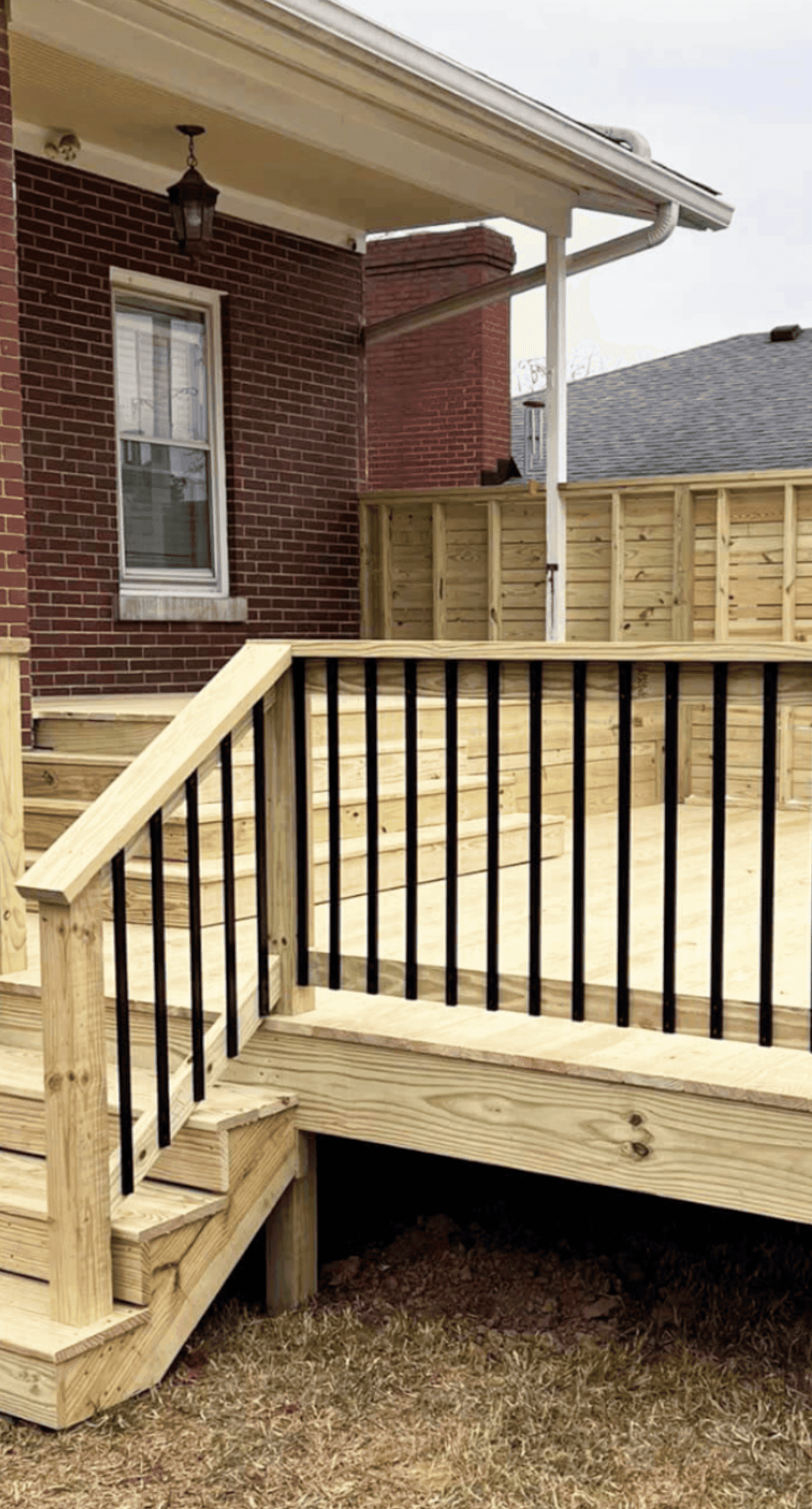
The deck in the photos on our projects page is the plain version of all this — pressure-treated boards, black metal balusters, steps, a matching privacy fence. Wood and composite both build a good deck. Neither survives a bad frame.
The short version
Pick the surface for how you want to spend your weekends. Pick the frame for how long you want the deck. Flash the ledger, tape the joists, get the footings below frost depth, use fasteners rated for the wood they go into, and seal every cut end. Those five things outlast any decision about board color.
If you want someone to look at what you have — an old deck you are deciding whether to re-board or tear off, or a bare yard and a back door — ask for an estimate and we will walk it with you before anyone writes a number.