The number on the shelf tag in a tile showroom is the material. It is the smaller part of what that tile costs once it is on your wall. The rest is labor, and labor does not scale with the price of the box — it scales with format. Two tiles at the same material cost, in the same shower, can land a long way apart on an estimate. One asks the wall behind it to be flat. The other asks the setter for hours of cutting and grout.
That is what catches people mid-comparison. You choose a tile, multiply by the square footage, and the tile line comes back as a different number than the one in your head.
What the trade means by large format, and by mosaic
Forget the showroom labels and think about behavior.
A large-format tile is one long enough on an edge that it stops following the surface it is set on and starts bridging it. Set a small tile over a shallow hump and it rides up and comes back down. Set a long plank across the same hump and its belly lands on the high point while the ends hang over the dips either side. That is not fixable with more mortar.
A mosaic is a tile small enough to be sold mounted on sheets rather than loose — glass, penny round, hex, pebble, small square. The sheet is the deception. It carries and prices like one unit, but it is many separate pieces, and edges are what a setter is paid for.
Between them sits ordinary field tile, the subway and the mid-size plank, where the labor rate for tile is quietly benchmarked. Move either direction and the rate goes up. That is why tile format is on the short list of things our bathroom remodeling page names as moving a quote — not because big tile is fancy, but because both extremes are slower to set.
Large format is a substrate decision before it is a tile decision
The word for what goes wrong is lippage: the height difference across a joint between two neighboring tiles. Small tile hides it. Large tile publishes it. Every tolerance in the wall or floor that nobody thought worth chasing shows up as a lit edge under a wall light, or a lip you catch with a mop.
Thinset is a bond coat, not a filler. Building mortar up under one end of a tile to chase a dip gives you a tile bedded thick at one end and thin at the other, with a void somewhere in the middle — and voids under tile are where cracks start. A dropped shampoo bottle. A heavy footstep near an unsupported corner.
So the flatness gets built before any tile arrives. On floors that means a poured self-leveling compound over a prepared subfloor, or a mortar float, once the deflection question is answered. On walls it means planing or shimming the stud faces before the backer board goes on. Both are line items, and both happen where nobody has anything photogenic to show you. Leveling the subfloor is the same argument in a different room, and the most common reason a large-format floor costs more than expected.
If the plane is already good, large format costs little extra to set. If it is not, the prep is the price. Which is why the honest answer to "how much more is the big tile" is that it depends on the wall — and why we would rather look first.
Deflection is the other flatness
Flat and stiff are not the same thing. A floor can be dead flat with nobody standing on it and still flex enough underfoot to crack grout joints, then tiles. What governs that is joist depth and span, subfloor thickness, and what gets added on top — a second layer of subfloor, a mortar bed, or an uncoupling membrane that lets small movement happen below the tile instead of through it.
Large format has less joint per square foot to absorb that movement, so it is the less forgiving choice over a floor that bounces. In an older house with long spans and a single layer of subfloor, the sequence is to stiffen the floor, then choose the tile — not the other way round, which is how a new floor ends up with a hairline crack across the planks.
The pattern changes the tolerance too
A long plank offset at its midpoint puts the crown of one tile — every plank has some bow in it — hard against the end of its neighbor, the worst available place for it. Most makers of long tiles ask for a shallower offset than the classic halfway brick-set for that reason, and print it on the box.
If you want the halfway offset anyway, that is a conversation to have before the tile is ordered, not while it is being set. Sometimes the answer is a different tile. We would rather say so early than hand over a floor with a shadow line down every joint.
What mosaic asks for instead
Mosaic asks almost nothing of the plane. Small pieces follow a gentle wave and nobody reads it. What it asks for is time, in a currency easy to underestimate: grout line. No other format carries as much joint per square foot, and every joint gets handled more than once — set, cleared, grouted, cleaned.
The work that gets missed when a mosaic is quoted:
- Sheet alignment. The joint between two sheets has to match the joints inside a sheet. Out by a hair and a grid appears under raking light, permanently.
- Clearing the joints. Mortar pressed up between the pieces has to come back out before it goes off, joint by joint, or the grout has nowhere to sit.
- The mesh or paper backing. Anything between the mortar and the back of the tile is a bond layer you did not choose. In a wet area that matters, and it is worth knowing what the sheets are mounted with before they go onto a membrane.
- Grout and haze. More joint is more grouting time, and textured, stone or glass faces hold haze that has to be worked off rather than wiped.
- Maintenance afterwards. More grout is more surface to keep, and grout and caulk are the joints that fail first in any bathroom.
Glass is nearly its own trade
Glass mosaic is translucent, so whatever sits behind it shows through — trowel ridges, mortar color, a skipped spot. It wants a white bonding mortar rated for glass, spread and flattened rather than combed and left. It chips when cut, so a glass job gets laid out around factory edges. None of that is exotic. All of it is slower, and a quote that treats glass as just another mosaic has not priced it.
The shower floor is not a style decision
Mosaic on a shower pan is not a look, it is geometry. A pan falls to the drain on several planes at once, and only a small tile can drape over them without relief cuts in the back. That is why nearly every tiled shower floor you have stood in was mosaic, whatever was on the walls.
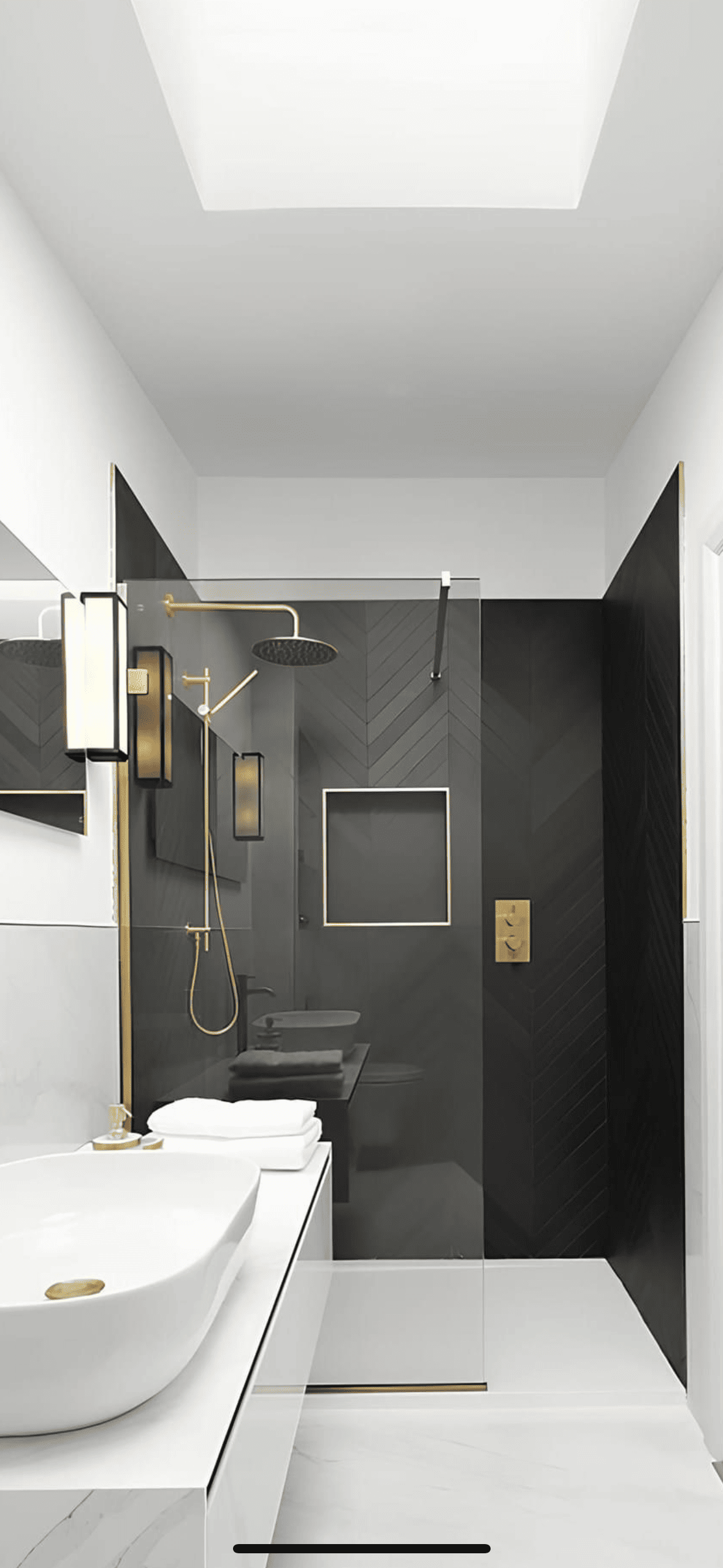
The exception is a linear drain, which lets the whole floor fall on a single plane toward one edge — and a single plane is something a large tile can sit on. That is one of the real changes when a shower goes curbless: the drain and the slope geometry decide which formats are available, long before anyone picks a color.
Small tile also puts more joint underfoot, and joint is grip. On a wet floor with no curb holding the water in, that is worth more than the pattern.
Where each format actually saves money
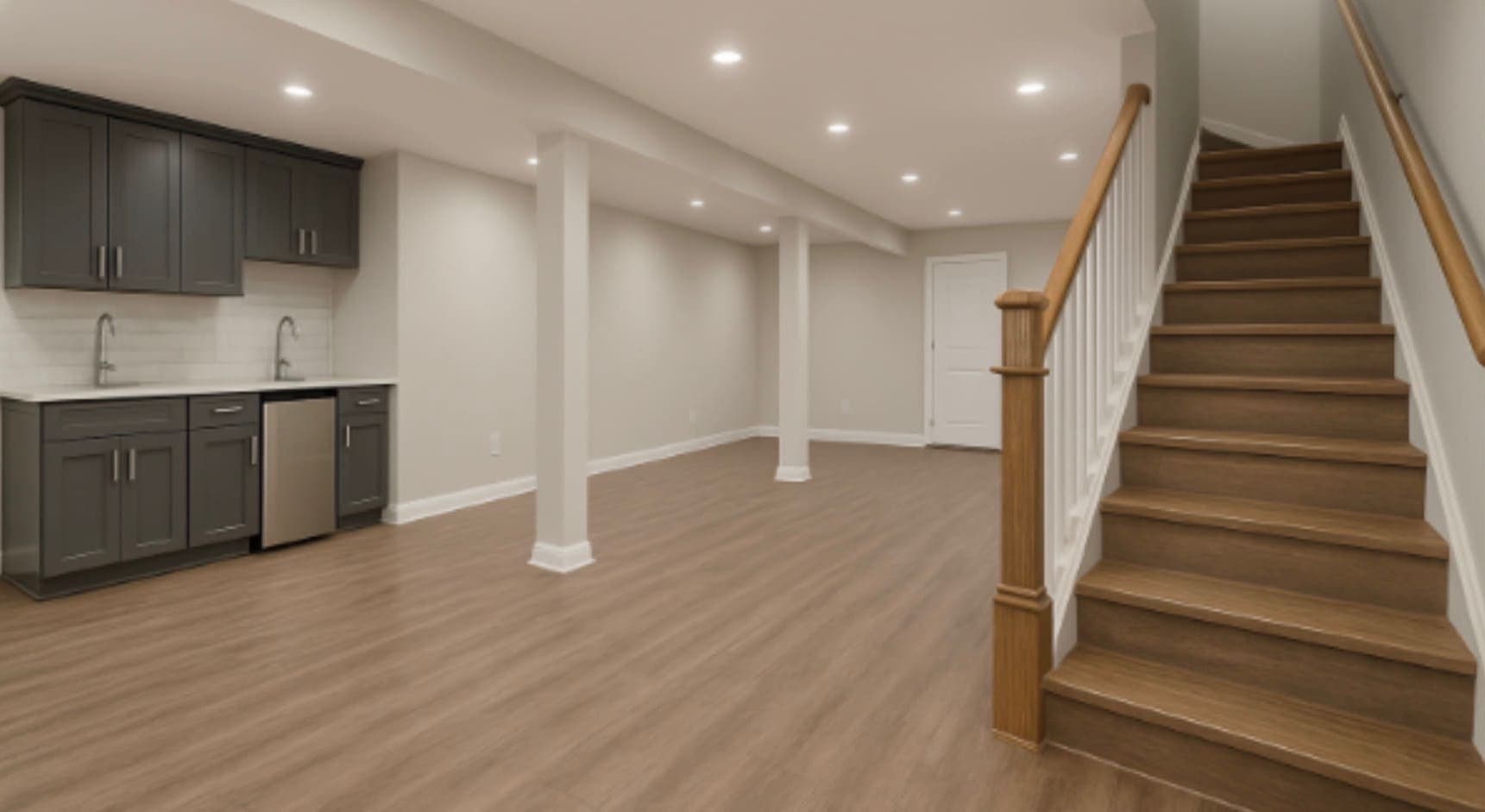
Large format earns its keep on big, open, already-flat planes. Fewer joints, fewer cuts, less grout to clean, and a crew that covers ground once the layout is snapped. A flat basement slab is close to the ideal case, which is why large tile turns up so often in finished basements and so rarely in small bathrooms.
Turn it round. A small bathroom floor has a toilet flange, a vanity, a door threshold and usually a floor register in it. Nearly every tile is a cut, and every cut in a large tile is slow, awkward and expensive to get wrong. The same room in a mid-size tile is a fraction of the cutting and the waste.
Mosaic saves nothing on labor, but it saves on prep where the substrate is imperfect, and it wastes very little — an offcut sheet is still tile. It also concentrates its cost. On a kitchen backsplash the tiled area is small enough that a slow format only costs real money over a small area, which is why mosaic makes more sense there than on a floor, and why on a backsplash where the tile stops is the bigger decision.
How format shows up on an estimate
Format rarely appears on a quote as the word "format". It hides in these lines, and they are the ones worth reading:
- Substrate prep — self-leveling compound, floating, backer board, membrane.
- Setting labor, priced by format rather than at one flat rate for everything.
- Waste allowance, which rises with pattern. Diagonal and herringbone eat more than a straight set.
- Mortar type. A large-and-heavy-tile mortar, or a non-sag wall mortar, is not the same product or price as a standard thinset.
- Edge treatment — metal profile, mitred corner, or a bullnose that may not exist in the tile you chose.
- Grout, and whether it is cementitious or epoxy.
- Movement joints, at the perimeter and through the field, which large format needs more of rather than less.
If the tile section of a quote is one line and one number, you do not have something to compare — you have a guess with a decimal point in it. Reading an itemized estimate line by line is how you work out which of two quotes actually included the prep.
And none of it matters if the layer under the tile is wrong. Format is a finish decision sitting on top of a waterproofing decision that has to be right first.
What it costs, roughly
We do not publish our own prices, for the reason we give everywhere else. What we can point at is independent research on this market: Angi's Indianapolis bathroom cost work and published Greater Indianapolis contractor cost guides put a bathroom remodel at around $134 per square foot, across a spread of roughly $70–$250 per square foot.
That spread is not mostly fixtures. A good part of it is what the surfaces demanded — how flat the substrate had to be made, how many cuts the format asked for, and how much joint somebody had to fill and then clean.
The short version
Pick the format for the plane it has to sit on, not for the photograph. Large tile is a bet on flatness, and the prep to win that bet is a cost you pay whether or not anyone names it. Mosaic is a bet on hours, and the hours are real, but they buy a surface that follows a slope and grips underfoot.
Between them, ordinary field tile is cheap to set and boring to talk about, which is why it is the right answer more often than a showroom will tell you.
When we walk a bathroom, the flatness of the walls and the bounce in the floor get checked before anyone talks about tile, because those two facts decide which formats are on the table at all. If you want the same done in yours, ask for an estimate and we will bring a level.