A countertop sample is a polished chip the size of your hand, handed to you dry, under showroom light, at room temperature. The counter it stands for will be none of those things. It sits beside a burner. It gets wet every day. It takes a pan from someone who was not thinking about it, and it sits under a west window all summer.
So the question is not which material is best. All of them lose to something. The question is which failure you can live with, and which maintenance you will still be doing years from now, when the kitchen has stopped being new.
Four forces, and what each one does
Every comparison below comes back to the same four things.
- Heat. Not only a hot pan set down, but thermal shock — a sharp temperature difference across a surface that would rather expand evenly.
- Abrasion. Knives, grit walked across the room and wiped along the counter, the base of a cast-iron pan dragged sideways.
- Water, and what is dissolved in it. Oil, wine, coffee, lemon. Two different problems live here. Staining is absorption. Etching is a chemical reaction with the surface itself. A sealer addresses the first and nothing at all about the second.
- Movement and load. Seasonal movement in wood, a corner clipped by a barstool, a slab asked to carry its own weight across an unsupported overhang.
Hold a material up against those four and most of the showroom language falls away.
Quartz, and what the resin decides
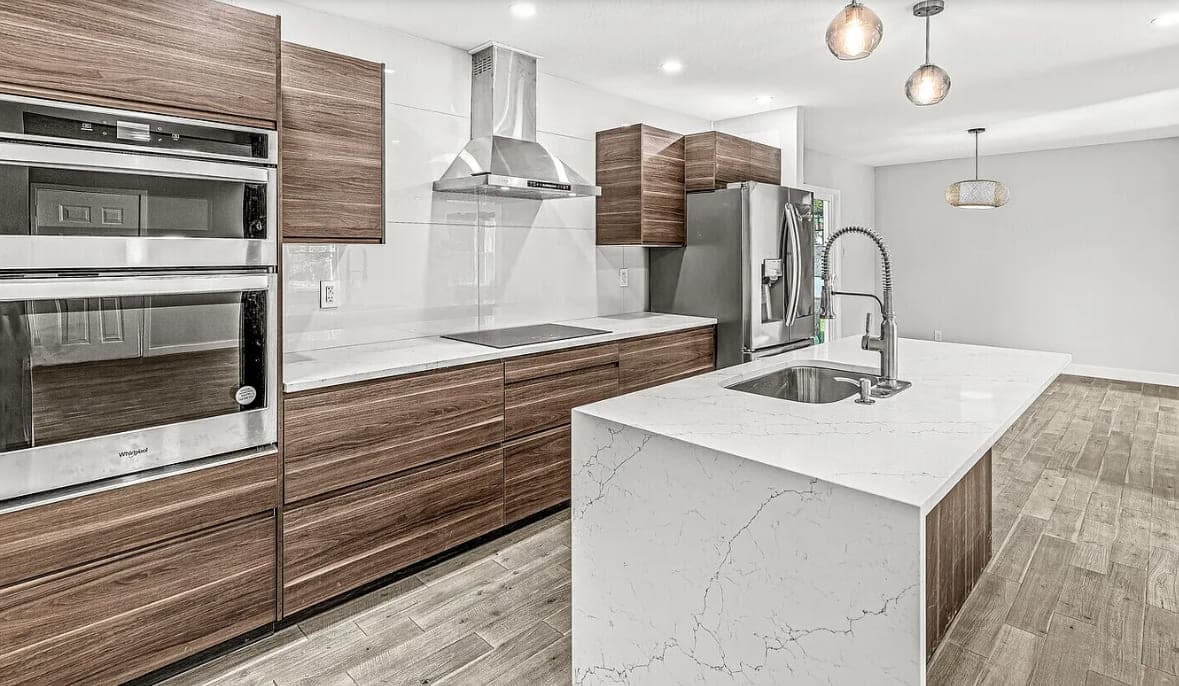
Engineered quartz is crushed stone held in a polymer resin with pigment, pressed into a slab. The stone makes it hard. The resin makes it non-porous — and the resin is also what sets every weakness the material has.
Non-porous is the real argument for it. Nothing to seal, ever. Oil does not darken it, wine sits on the surface until you wipe it, and the cut edge at an undermount sink is as closed as the face. It is also predictable: you can see a sample and know what the slab will look like, and order matched slabs for a long run.
Heat is where it gives out. Set a pan straight off the burner on quartz and you can scorch the binder. That mark is not a stain being drawn out of the surface — it is the resin itself, changed, and it does not come back. The same goes for a slide-in range where the oven body meets the stone. Keep a trivet in the drawer nearest the range and this never becomes a problem.
Sustained direct sun is the other one. Ultraviolet light yellows some resins unevenly, so the shaded strip under a wall cabinet stays put while the run in front of the window drifts. For a wall of south-facing glass, or a covered outdoor kitchen, that matters.
Chips happen at edges and cutouts, and they are repaired with color-matched resin. The repair holds. It is also visible in raking light, because the factory polish cannot be reproduced on site the way stone can be re-honed.
Granite, and what porous actually means
Granite arrives as a slab cut from a block that came out of the ground, and 'granite' is a commercial family rather than a specification. Density, absorption and mineral content vary enormously from one stone to the next, so two slabs in the same yard can behave like different materials.
Heat is its strength. A pan set down does not mark it, and no trivet discipline is required from anyone in the house.
Porosity is the trade. Some granites are nearly closed and some take up oil readily. You can test the one you are looking at: leave water on an unsealed offcut and watch. If a dark spot appears quickly and lingers, the stone is open and will want sealing more often. Lemon juice on the same offcut tells you whether what is sold as granite holds enough calcite to etch.
Sealing, honestly
A penetrating sealer is not a coating. It sits inside the pores and makes them repel liquid, and it wears out with ordinary cleaning. Re-applying it is a rag and a bottle, not an event. But it does have to happen. If nobody in your house is going to remember, that is a real argument for quartz, and it is better made at the design stage than discovered by a bottle of olive oil.
Buying a slab, not a sample
With natural stone you are not choosing a product, you are choosing a specific slab. Go to the yard and look at the whole thing standing up. Note where the sink cutout will land, because a dramatic vein through the middle of the slab may be the part that gets cut away. Ask which slabs are being tagged for your job and whether they came off the same block, because that is what decides how well the pattern carries across a seam — which is a subject of its own, covered in seams, cutouts and edges.
Quartz or granite: the part people actually want settled
Both survive normal kitchen use. They fail differently.
- Maintenance. Quartz asks nothing. Granite asks for a sealer, occasionally.
- Heat. Granite shrugs it off. Quartz does not, permanently.
- Predictability. Quartz is a manufactured product and looks like its sample. Granite is a slab, and the sample is a suggestion.
- Repair. Both chip. Stone can be re-polished on site. Quartz repairs read as repairs in the right light.
- Sun. Granite is indifferent. Quartz resin can yellow under years of it.
If you cook hot and hard and you want a surface nobody else has, granite. If you want a counter that never asks anything of you and a trivet by the range is an easy habit, quartz. Neither survives being treated like the other one.
Butcher block, and the joint next to the sink
Wood is the only surface here that moves with the season, and one of the few you can sand back and repair yourself.
Grain orientation is the first choice. Edge grain is the common one and the most stable. End grain — the chopping-block look — is kinder to knives and thirstier for oil. The second choice matters more: a penetrating oil finish or a film finish. Oil can be chopped on, sanded and refreshed in place, and it needs redoing. A film finish is harder and far more tolerant of water, but you cannot cut on it, and damage means refinishing the whole top rather than a patch.
Wood expands across the grain in a humid Indiana summer and gives it back during heating season, which is why a wood top is fastened to the cabinets through slotted holes or figure-of-eight clips and never glued down solid. Every face gets finished, including the underside and the raw edge of the sink cutout. Seal one face and not the other and the top takes on moisture unevenly and cups. The mechanism is the same one that moves cabinet doors and floors here, described in humidity and wood movement.
That leaves the undermount sink. Its cut edge lives directly under running water at the wettest point in the room. It can be done, with the right finish and real diligence. Our honest advice is to put the sink in another material and the wood where you actually work.
Laminate, solid surface, porcelain
Laminate
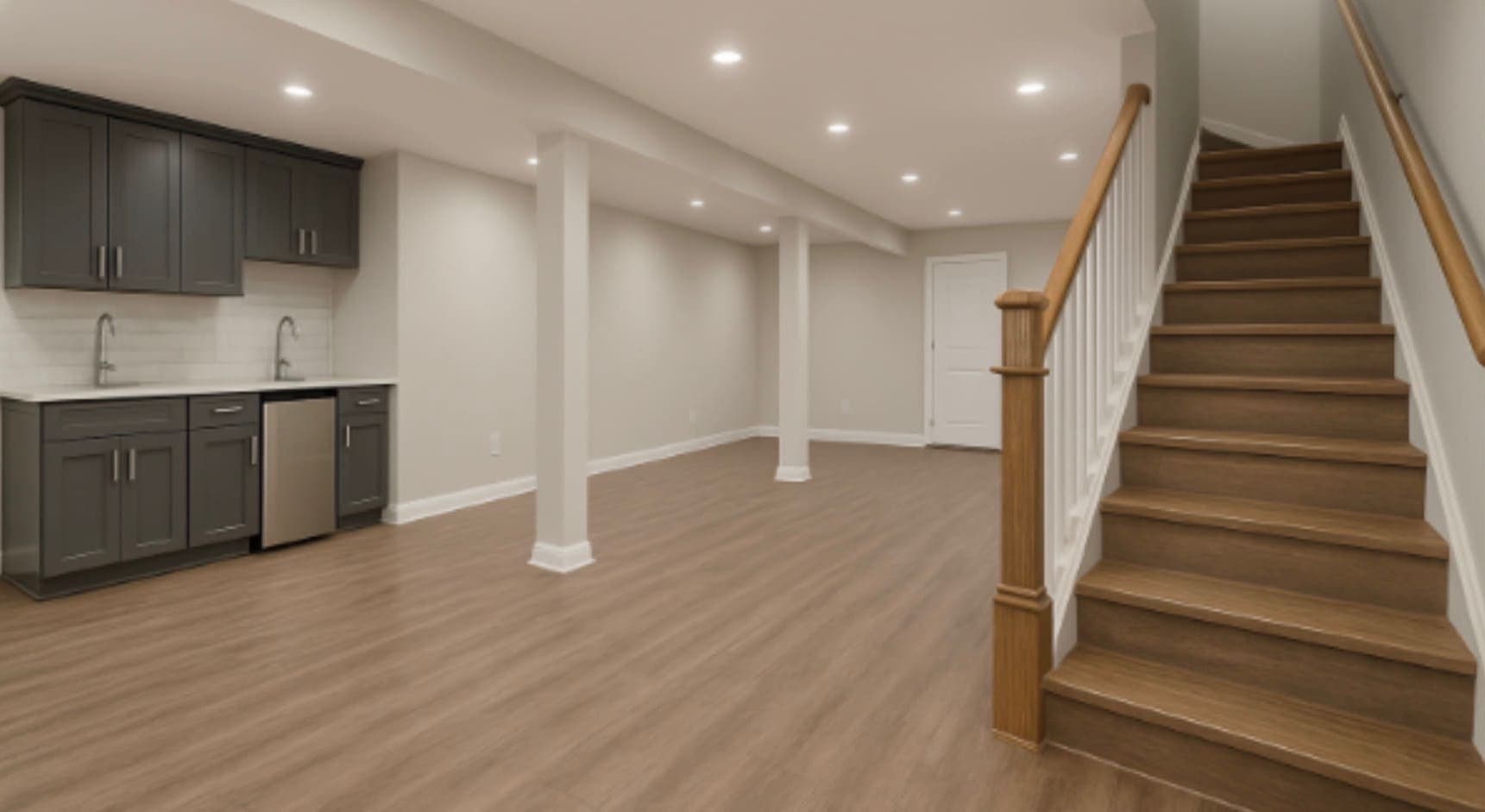
Better than its reputation, and the right answer more often than people admit. Current profiles wrap the edge, so there is no brown seam line. The core is particleboard, and that is the whole story: water that gets into a seam or the sink cutout swells the core, and swelling does not reverse. No heat tolerance, and generally no undermount sink. Where it earns its place is a laundry, a workshop, a basement bar you intend to change later, or a kitchen where the money is better spent on the cabinets — a trade covered in repaint, reface or replace.
Solid surface
Acrylic sheet, non-porous, joined chemically so that a long run reads as one continuous piece with no visible seam. Sinks can be molded in, which removes the rim and the caulk joint that eventually discolours. Scratches and burns sand out. Heat is its weakness, and it dents. A strong answer for an odd-shaped run, and for bathrooms.
Porcelain and sintered stone
Fired sheets, extremely hard, indifferent to heat, acid and sunlight, and thin enough that edge thickness is made by mitring two pieces together. Unforgiving fabrication: cutouts and mitred corners are where it chips, and the difference between a good result and a bad one is whether the shop cuts it routinely. Ask that directly.
Marble, soapstone, and surfaces that change
Marble etches. Calcium carbonate meets acid and dulls, and no sealer prevents that, because sealing addresses absorption and etching is a reaction at the surface. A honed finish hides it far better than a polished one. If a ring left by half a lemon will bother you every time you walk past, marble is the wrong material for a kitchen island and a fine one for a baking counter or a guest bath.
Soapstone is non-porous, unbothered by heat and acid, and soft. It scratches and dents, takes mineral oil to darken evenly, and any mark can be sanded out by you. Concrete is sealed, heavy, and hairline cracking is characteristic of the material rather than a defect — which is only acceptable if you agree with that sentence.
The common thread is that these surfaces change. Some people call the result patina and some call it damage, and both are describing the same counter.
What the material decides about the rest of the room
The surface also sets things that have nothing to do with looks.
Support comes first. Stone at an island overhang carries itself only so far before it needs steel or corbels underneath, and how far depends on the material and the thickness — a fabricator's answer, not a blog's. It arrives early, because it moves the cabinets and the seating plan alongside the clearances around an island.
The cabinet run has to be level and shimmed before anyone templates, because the template records the cabinets you installed, not the ones on the drawing. A dishwasher cannot be screwed up into stone, so it hangs from side brackets or a bracket fixed to the cabinet. An undermount sink needs a material with a closed cut edge. A full-height slab backsplash is a different order and a different price from tile, and where the tile stops is a decision of its own.
The sequence changes too. Templating happens after the cabinets are set, and the counter arrives once the shop has cut it. That gap is a stretch with no counter and no sink, and it is worth knowing about before it starts rather than during.
What it costs, roughly
We do not publish our own prices, for the reason we give everywhere on this site: a number written before anyone has seen your kitchen is a guess. What we can point at is what independent research says about the whole room. Independent cost research puts a typical Indianapolis kitchen remodel in the region of $18,000 to $24,000, across a full spread of roughly $8,000 to $40,000 depending on how much of the room changes.
Inside that, the counter is one of the four things that move the number, next to the cabinets, whether services get moved and the appliances — which is how the kitchen remodeling page lays it out. Material choice moves the total less than people expect. Fabrication moves it more: seams, cutouts, edge profile and overhang support are a large part of what you pay for, whichever slab you picked.
The short version
Take a sample home and leave it on the counter, not in a drawer. Look at it in morning light and under the lights you will actually be cooking under at night. Put oil and lemon juice on an offcut and leave them there. That tells you more than any comparison, including this one.
Then decide against how you use a kitchen rather than how it photographs. The surfaces we have installed around Fishers and Hamilton County are in recent work. If you want someone standing in your kitchen talking through the trade-offs on your actual layout, ask for an estimate and we will walk it with you.