A coating that peels off a basement slab almost never failed as a coating. It failed as a bond. The paint did what paint does — it stuck to whatever it was rolled onto — and then either something pushed it off from underneath, or the thing it stuck to let go of the concrete. Two different failures, two different fixes, and both get reported the same way: the paint was no good.
The same bucket goes down on a garage floor in Westfield and holds. It goes down on a basement slab a few miles away and lifts in sheets by the second spring. Nothing about the product changed. The concrete did.
What is pushing the coating off from below
A below-grade slab sits on ground that is rarely dry. Water moves into the concrete by capillary action and leaves the top face as vapor, driven by the difference in vapor pressure between damp soil and a heated room. That is vapor drive. It runs all year, rises after a wet spring, eases in a dry fall, and never goes to zero.
On a bare slab nobody notices — the moisture arrives and evaporates off the surface. Roll a film over the top and you have closed the only exit. It keeps arriving and collects at the bond line, where it becomes pressure against the weakest thing in the assembly: the grip of a layer measured in thousandths of an inch.
You can read the failure off the flake. Lift a peeling piece and look at the back:
- A damp underside, or a wet ring on the concrete beneath it. Vapor pushing through. The coating was the wrong call, or the slab needed mitigation first.
- Small domes with liquid in them, out in the field rather than at the edges. Osmotic blistering — salts drawing water through the film itself.
- A slick, soapy feel on the back of the flake. Moisture moving up through concrete carries alkali with it, the surface pH climbs, and some binders saponify at the bond line. The coating did not lose its grip so much as get dissolved off it.
- Clean, dusty concrete on the back and a sharp edge to the peel. Not a moisture failure at all. That is prep, and it is the more common one.
The half of the failure that happens on top
Concrete looks like a simple surface. It is not one. The face of a poured slab is the weakest part of it — troweling brings fine cement paste and water to the top, and that layer, laitance, is soft, dusty and only loosely attached to the good concrete underneath. Paint bonded to laitance takes the laitance with it.
Then there is everything applied since. A curing compound gets sprayed on the day of the pour to hold water in while the concrete gains strength, and it is a membrane by design — still up there decades later, invisible, keeping things from soaking in. Older slabs carry a sealer somebody rolled on and forgot, a previous coat of floor paint, a patch of mastic from a floor that came out.
There is a test for that which costs nothing. Drop water on the bare concrete in several places. If it darkens the slab and soaks in, the surface is open. If it beads and sits there, something is sealing that concrete already, and no amount of cleaning will make a coating stick over it.
Clean is not the same as profiled
Mopping a slab gets it clean. It does not give the coating anything to hold. What a film needs is mechanical profile — enough tooth for the resin to key into, cut into sound concrete after the laitance and the old finishes are off.
That means diamond grinding or shot blasting with vacuum extraction running, because concrete dust is silica and grinding it dry into a closed basement is not a corner worth cutting. Acid etching is the shortcut and a poor one: it does nothing to a curing compound or an old sealer, it profiles unevenly, and unless it is neutralized and rinsed it leaves salts behind that cause the blistering nobody can explain later.
Prep is most of the labor and most of the cost. A quote for a coated basement floor with no grinding line in it is not a quote for a coated floor. It is a quote for paint.
Test the slab before you buy the bucket
The moisture question can be measured instead of argued about. An in-slab relative humidity probe reads the concrete rather than the weather that day, a calcium chloride test reads the rate coming off the surface, and every coating manufacturer publishes limits for both. The limit that governs is the one printed by whoever made the product you chose.
That is the same testing that decides what flooring survives over concrete, so it gets done once and answers both questions. Read the result for what it is, though. A number is a snapshot of one week, and a marginal slab in October is not a pass in April. It also has to be taken with the house behaving like a house — heat or cooling on, doors shut, no construction fan running.
If the reading is bad, a different coating is not the answer. Finding where the water comes from is — grading, downspouts, window wells, the joint where the slab meets the wall — which is the subject of reading a basement for water before anything gets framed.
The products, sorted by whether they can peel at all
Penetrating sealers and densifiers
Silicates and silane-siloxanes soak into the concrete and react inside it rather than forming a film on top. Nothing sits on the surface, so there is nothing to disbond. A densifier hardens the face and cuts dusting; a water repellent reduces absorption. Neither changes the look much, neither is a vapor barrier, neither hides a stain. On a damp slab this is the category that cannot fail the way the others fail.
Acrylic sealers
A thin film, usually water-based, that wets the color of the concrete and gives a light sheen. It is the most breathable of the film formers, which is why it is the most forgiving below grade. It is also the softest — it wears through in traffic lanes and under chair casters, and it recoats, which is the trade being made.
Epoxy
Two components mixed on site, curing into a hard, thick, chemical-resistant film. The most durable-looking option on the shelf and the most sensitive to everything above: slab moisture, surface profile, mix ratio, pot life, temperature. Epoxy fails less often because the epoxy was wrong than because the slab under it was never tested and never ground.
Polyaspartic and polyurea
Fast-curing, more flexible than epoxy, more tolerant of a cold slab, and the usual topcoat over a broadcast flake system. The working window is shorter than epoxy allows, which is a benefit on the calendar and a hazard in the hands.
One-part floor paint
The porch-and-floor product from the paint aisle. Thin, cheap, on with a roller in an afternoon, and what people mean when they tell us the coating peeled. Over prepped, dry, tested concrete it is a serviceable finish for a low-traffic utility space. Over a slab with vapor coming through it, it is the fastest way to turn one problem into two.
Grind, polish or stain
Grinding and polishing the slab, or taking an acid or dye stain into it, gives you a finished floor with no film to lose. The color is inside the concrete and the mechanical prep is the finish. On a slab that will not accept a coating this is often the honest answer, and it is worth looking at a ground slab before deciding it is a compromise — several of the basements in our project photos live with the concrete rather than over it.
Moisture-mitigating primers, and their honest limit
There is a real product category here: high-build epoxy primers made to go over slabs above ordinary moisture limits, rated by the manufacturer to a stated internal humidity. They work. They also cost more than the topcoat going over them, and they are specified against a measured number rather than a hope.
What they do not do is fix a water source. A mitigation primer manages ordinary vapor drive through a sound slab. It is not a response to a floor that gets wet every time it rains, and nothing rolled onto the top of concrete has ever solved drainage. The same logic governs the walls: masonry paint sold as waterproof peels off a foundation for the identical reason, which is why framing a basement wall so it stays dry is a question about where the vapor is allowed to go.
The window to do this in Central Indiana
A basement slab sits near ground temperature all year, well below the room in July. Warm humid air coming down the stairs meets that cold surface and gives up its moisture onto it, so a slab can be visibly damp in a week with no rain in it. Coating over condensation is coating over water.
That is a scheduling constraint, not a footnote. Manufacturers give a minimum slab temperature and a dew point margin, both measured at the floor rather than on the thermostat. Late spring and early autumn are the easiest windows. Mid-summer without a dehumidifier running is the hardest, and it is the season most people pick. Run one before, during and after — the same machine a finished basement needs anyway, and it wants somewhere to drain rather than a bucket somebody empties.
Sealing a slab is not radon mitigation
This one matters more here than most places. Hamilton County carries an EPA Radon Zone of 1, the highest of the three, meaning the predicted average indoor screening level is above 4 pCi/L. The EPA's guidance is to fix at 4 pCi/L or higher and to consider fixing between 2 and 4.
Sealing cracks and the slab-to-wall joint is a supporting measure in a radon strategy. It is not the strategy. The standard fix is sub-slab depressurization — a system that changes the pressure under the floor so soil gas leaves by a pipe instead of into the room — and a coating does nothing to that pressure difference. Read anything sold as a radon sealer with that in mind. Test first, and plan the system before the slab work, because finishing a basement changes the radon picture in the whole house.
When a coating is the right tool
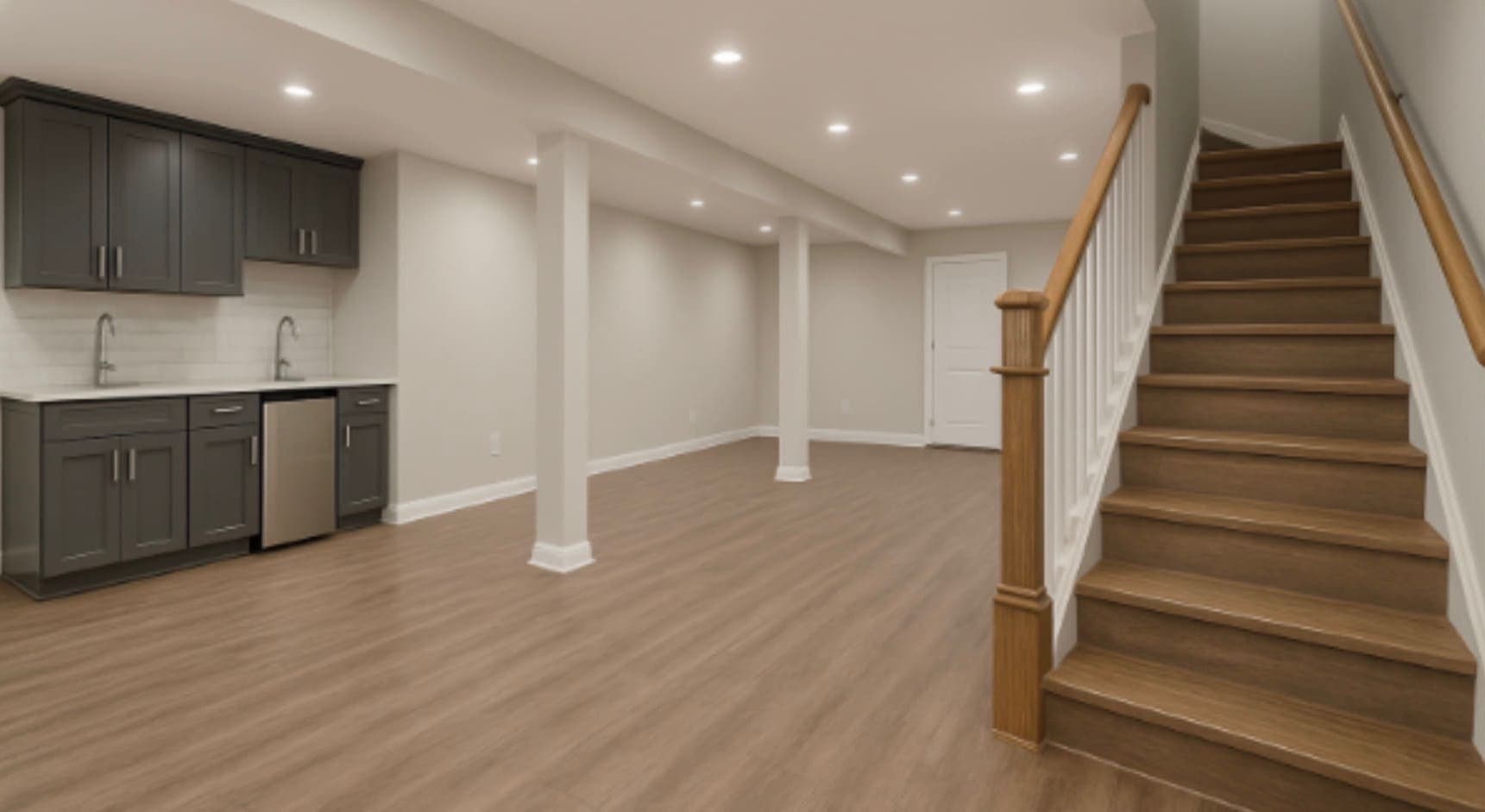
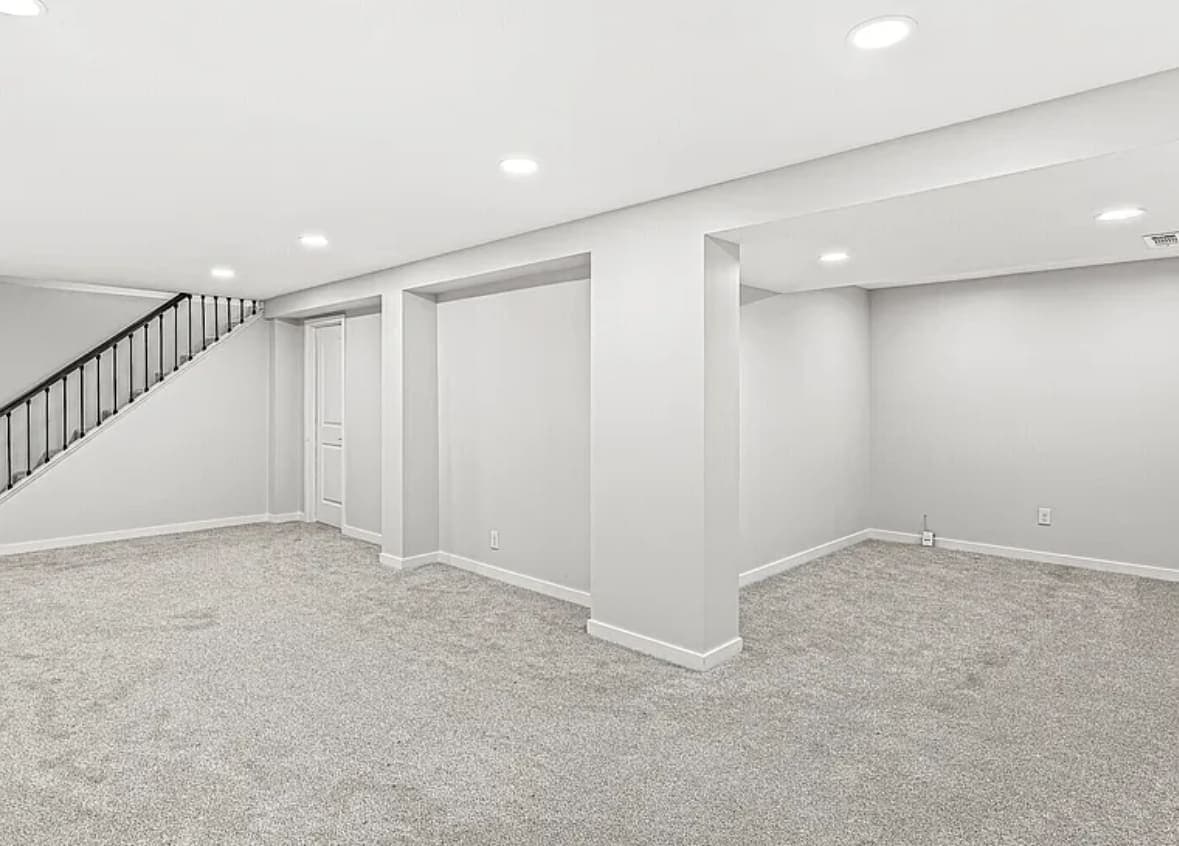
It is a good answer for the utility half of a basement — storage, workshop, mechanical space, the run under the stairs — where you want a floor that stops dusting and cleans up without costing what a finished floor costs. It is the wrong tool as a moisture fix, as a substitute for a specified vapor retarder under a finished floor, and as a way to make a damp basement feel dry. That last one makes things quietly worse: the slab was the surface doing the drying, and now it is not.
What it costs, roughly
We do not publish our own prices, for the reason we give everywhere else: a number written before anyone has seen your basement is a guess. What we can point at is what independent research says people here spend on the finished space overall. Published Indianapolis basement finishing research, Angi's included, puts it at roughly $25 to $65 per square foot, which works out to about $25,000 to $65,000 for a 1,000 square foot basement.
Slab prep and coating sit inside that, and the split is not the one people expect — the material is the small half, the grinding is the large one. It is also the first line deleted when a number has to come down.
The short version
Coatings do not peel because of the paint. They peel because moisture was moving up through the slab with nowhere to go, or because the film was bonded to laitance, a curing compound or somebody's old sealer instead of to concrete. Test, grind, then pick a product to match what the test said — in that order, every time. If the slab will not take a film, choose a finish with no film to lose.
That is the same sequence that governs everything else down there, which is why the concrete gets checked before anything gets drawn on the basement finishing page. If you want someone to look at yours and say plainly whether it will hold a coating, ask for an estimate and we will walk it with you.