A tile that grips under a dry hand in a showroom tells you almost nothing. Your hand is dry, the sample is clean, and neither of those things is ever true of a bathroom floor. The condition that decides whether somebody goes down is a wet foot on a surface carrying a film of soap and conditioner, at the moment a person steps out of a shower with their weight already moving.
So the words on the box are not much help. Matte is a look. Textured is a look. Non-slip is not a thing that exists — any floor is slippery under the right film — and a manufacturer who has tested a tile does not need that word. They have a published test result to hand you instead.
Two things make a wet floor grip: the texture of the tile face, and the grout joints between the pieces. Almost everything else is packaging.
The shower floor and the bathroom floor are not the same problem
They get treated as one decision because they get bought on the same afternoon, off the same display. As far as traction goes they are different rooms.
A shower pan is wet every time it is used, always walked on barefoot, always sloped, always carrying soap. It needs the most traction available and it can afford texture, because it gets rinsed constantly and it has a drain.
The main bathroom floor is wet occasionally and unpredictably. It is level, it has no drain, it gets walked on in socks and in shoes, and it has to be mopped. It needs enough traction, not maximum traction. A floor grippy enough for a shower pan is one you will resent cleaning and one that feels harsh under a bare heel.
And the spot where people actually fall is neither. It is the landing zone — the strip of level floor in front of the shower or tub, where a wet foot arrives on a surface with no slope, no drain, and often a rug that slides. If you get one part of this right, get that strip right.
What a datasheet says, and what it does not
There is a real measurement under this. The American national standard for ceramic tile includes a wet dynamic coefficient of friction test — the AcuTest — and sets a threshold a tile has to clear to be considered appropriate for level interior floors walked on wet. Manufacturers who test their product publish that value on the technical datasheet.
Which is the practical instruction: ask for the datasheet, not the shelf tag. If a tile has a published wet DCOF value, somebody tested it. If nobody at the counter can produce one, you are choosing a bathroom floor on adjectives.
Now the caveats, because a misread number is worse than no number. The test is run on clean tile with water. Not soap, not shampoo residue, not the film hard water leaves behind, and not a floor mopped with something that left a coating. It is also run level, which says nothing directly about a sloped pan. Clearing the standard makes a tile eligible for a wet floor. It does not make the floor safe.
You may also see a European ramp-test rating, an R value measured with a person in boots on an oiled ramp. That one was built for commercial kitchens and does not translate cleanly to bare feet. The barefoot wet-ramp classification, graded A, B and C, is the one that actually describes a shower floor, and it is rarely published on tile sold here. PEI is a third thing again — an abrasion class, how well a glaze survives being walked on, not how well a foot holds onto it. A hard-wearing tile can be glassy.
Texture is a surface, not a finish name
Traction on the tile face comes in two scales, and they behave differently underfoot.
Micro-texture is is roughness built into the glaze — grit, a slight tooth, a matte broken surface. You can feel it with a fingertip, but the tile still reads flat and still mops normally. That is what most competent bathroom floor tile uses.
Macro-texture is relief you can see: a structured face, a slate-look pressed surface, a raised grain in a wood-look plank. It grips harder and holds dirt harder. In a pan, rinsed several times a week, that is a fair trade. On a family bathroom floor it means a mop skates over the high points and leaves the low ones, and you end up with a brush.
There is a third option that solves the wear problem. Unglazed, through-body porcelain is the same material all the way down, so traction is a property of the tile rather than a coating on top of it. A glaze can wear through in a traffic path and take its texture with it. Through-body wears into itself. It is not the prettiest category and it is the most durable answer for a floor that has to stay grippy.
Somebody will offer to fix a slippery floor with an acid etch or a topical coating. Both work briefly, then dull unevenly or wear off in the exact path where you needed them. If the tile is wrong, it is wrong.
Grout does more of the work than people expect
Set the same tile in two formats and the wet traction changes even though the material did not. That is the joints.
Every grout line is an edge your foot registers and a shallow channel water can run into instead of sitting under your sole in a continuous film. Grout also cures slightly below the plane of the tile face, so the floor is a fine grid of ridges. More joints per square foot means more of that. It is the real reason shower pans get small tile — hex, penny round, small squares — and it matters more than which small tile you pick.
It also means the joints have to stay intact. A pan is the harshest place in the house for grout, and once joints erode you lose traction and drainage together. Which joints move and which ones crack is its own subject, and the difference between a grout joint and a sealant joint is worth understanding before anybody grouts your floor.
Two details we would insist on. Sealer on a shower floor should be penetrating, not film-forming — a film-forming sealer sits on top of the tile and can leave a pan slicker than it was before sealing. And mosaic sheets need full thinset coverage under every piece, not a skim that catches the mesh. A tile that pops loose in a wet pan is a trip point and an entry for water.
Choosing a material with the wet floor in mind
Porcelain and ceramic are where most bathroom floors land, and the range inside that category is enormous — a polished porcelain and a structured porcelain from one manufacturer behave nothing alike wet. Judge the tile, never the category.
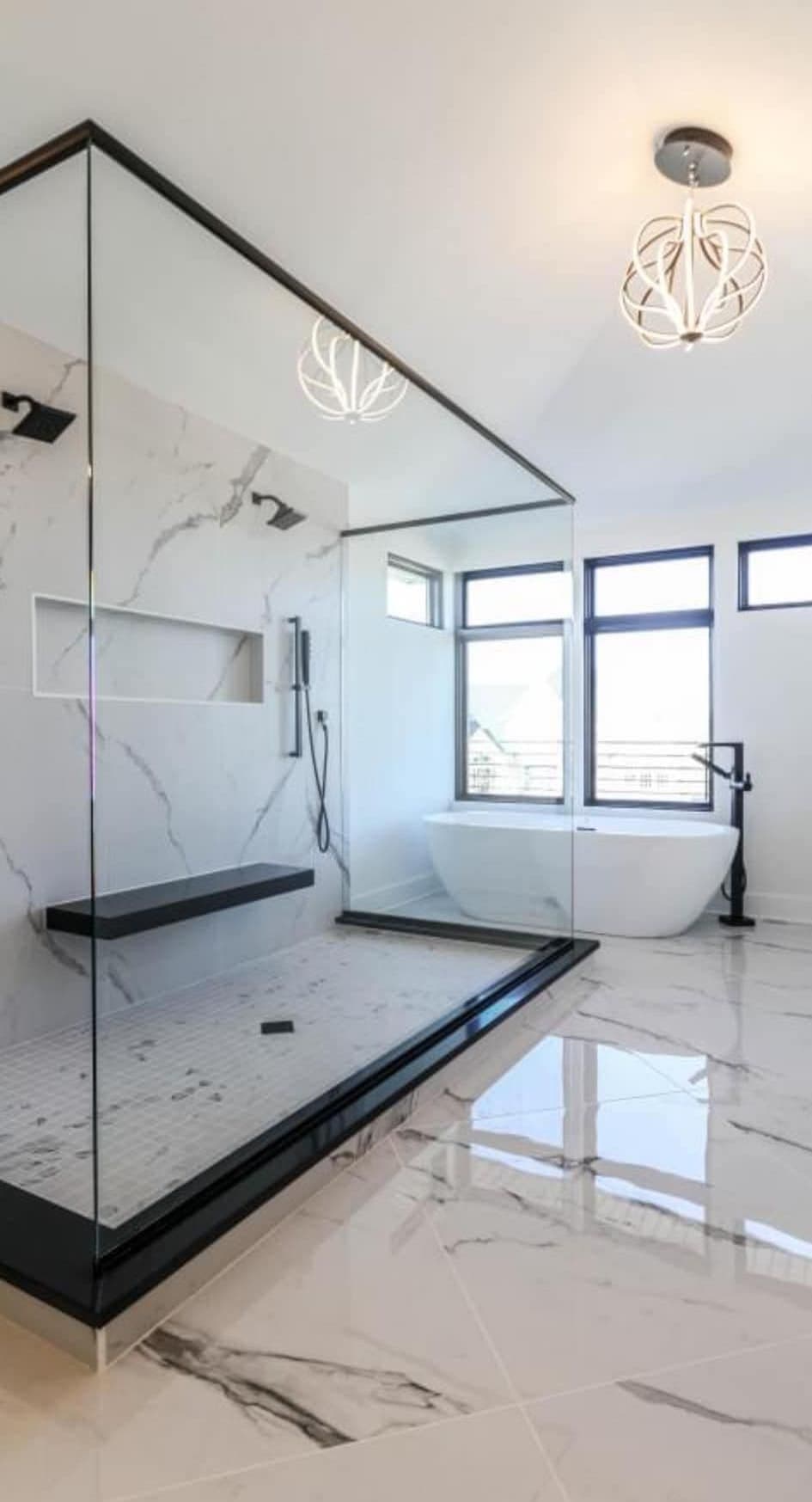
Natural stone splits hard. Cleft-face slate is one of the grippiest things you can put on a floor, and honed limestone or tumbled travertine hold up reasonably. Polished marble in a shower pan is a bad idea and we will say so — glassy wet, and it etches under ordinary bathroom products in a way that looks worse without gripping better. Honed marble, cut small, is a defensible compromise. Polished is not.
Pebble floors deserve a specific warning. They look like the answer and the irregular surface does grip. They are also the largest grout area of any floor we set, uncomfortable under some feet, and the hardest surface in a bathroom to clean. People love them for a year.
Sheet vinyl and good LVT perform quietly well wet, run warmer underfoot than tile, and make sense in a hall bath. Their limits are seams and standing water at the perimeter, the same fight a floor inside a back door has to win.
Flat matters as much as grippy
Water that ponds is a slick spot no matter what the tile is rated. A floor that is level but not flat collects a shallow puddle in every low spot, and the puddles land in the same places every time — usually right where you step out.
So the substrate comes first. On a bathroom floor that means a flat, stiff deck prepared before any tile arrives, because leveling the subfloor stops both the ponding and the lippage that catches a toe. In a pan it means a slope that falls to the drain on every line, not just the one somebody checked.
Format interacts with this. A linear drain lets a pan fall in a single plane, which is what makes larger tile possible in a shower at all, and that plane has to be true across its width — a large-format pan punishes a lazy float in a way mosaic never will. If the shower is going to be curbless, the floor structure and the slope become framing decisions made long before tile is ordered.
The room decides how often the floor is wet
Traction is a property of the assembly, and part of that assembly is not tile. A bathroom that stays damp has a wet floor for hours after a shower rather than minutes, and every film on it stays live. That is a ventilation problem before it is a tile problem, and the fan is the cheapest fix on this list.
A heated floor dries the surface faster, which is a real traction benefit nobody sells it on. It gets decided at the same moment as the tile, because it lives in the mortar underneath.
Then the ordinary things. A bath mat with a rubber backing rather than a rug that slides. A towel within reach of the shower. A door that does not swing into the landing zone. And blocking in the walls while they are open, so a grab bar can go where it is needed later — the full argument is on building accessibility in early, and it costs almost nothing at framing.
What to do with a sample
Take one home. Wet it under the tap, put a drop of body wash on it, tip it slightly, and stand on it barefoot. Cruder than the lab test, and it tells you more than a showroom does. Then rub something greasy into it and clean it off, because the floor you can live with is the one you can clean.
Ask the supplier for the technical datasheet with the wet DCOF value on it. Ask what format the pan will be set in and how the joints will be treated. And be honest about who uses the room — a primary bath for two adults and a hall bath used by kids and grandparents are not the same brief, which is the reasoning behind spending differently on a guest bath and a primary.
The short version: small format with plenty of joints in the pan, a tested tile with moderate texture on the main floor, a flat deck under both, no polished anything where feet land wet.
The rest we settle in the room, because the landing zone in front of your shower is a specific patch of floor and not a general principle. It gets decided at the walkthrough, with the rest of the bathroom remodeling scope we quote from. If you want somebody to look at yours, ask for an estimate and we will walk it with you.