Stand on the spot and shift your weight onto it slowly, then step back off it. Most squeaks talk twice — once as the load arrives and once as it leaves. That pair of noises tells you more than the age of the house does. A squeak is a gap somewhere under your foot, and something crossing that gap as the floor deflects into it.
Which is why nothing you spray, wax, sand or recoat touches it. The board you are standing on is rarely the thing making the sound. It is the messenger.
Three noises wearing the same word
A floor is a stack. Joists, a subfloor deck fastened across them, sometimes an underlayment, then whatever you see. A squeak starts at one of those layers, and which one decides the repair.
A fastener moving in wood. A nail shank slides in its own hole as the deck flexes, and what you hear is steel dragging on the wood around it. Short, sharp, in one small place, repeating in exactly the same spot every time. The most common squeak in a nailed floor.
Two pieces of wood rubbing. The deck lifts off the top of a joist and drops back onto it, or two panel edges meet over nothing and grind on each other. A lower, longer noise — a groan rather than a chirp — covering a stripe rather than a point.
The finish floor working against itself. Tongue rubbing in groove, or a floating plank flexing over a hollow and creaking at the locking joint. You can usually tell this one by feel: the give is right under the surface rather than somewhere below it.
Same word, three repairs. Price a squeak before working out which one it is and you are guessing.
Why the gap opens
Framing lumber arrives at a house wetter than it will ever be again. Once the building is closed in and heated, the joists give up moisture and shrink across their depth. The deck was nailed tight to a joist that has since moved down and away from it, so every nail in that bay holds a board that no longer sits on what it was nailed to. Step on it and the board travels to meet the joist. Step off and it comes back.
The rest of the causes stack on that one:
- Unequal crowns. Joists go in crown up and no two crowns match, so the deck bears hard on one and hovers over its neighbor. It reads as a hump under a straightedge, which is why flatness and squeaks get checked in one visit.
- Nails, not screws and glue. Subfloor adhesive run along the top of every joist before the deck goes down is the cheapest squeak prevention there is, and it is invisible in a finished house. Plenty of decks went down with nails and no adhesive under them at all.
- Unsupported panel edges. Where a deck seam lands between joists with no blocking under it, both edges deflect independently and rub.
- Somebody cut it. A joist notched at the bottom edge, or bored oversize and low, to get a drain or a duct through it loses stiffness in exactly the bay where the floor now moves.
- Something underneath settled. A post on a slab with no footing, a beam carrying more than it was sized for.
In older Hamilton County houses we find several of these in one room, often alongside an addition framed to a different standard than the part it was joined to.
The squeak that shows up every winter
If a floor is quiet in August and chatty by January, the season is doing the work. Heating season pulls moisture out of every piece of wood in the house. Joists shrink further, the deck shrinks further, and gaps that were closed in humid weather open. Come spring the wood takes it back and the noise fades.
That is ordinary wood movement here, not damage, and it has one practical consequence. A floor screwed down in February is fixed at the widest its gaps will ever be. Do the work in August, with everything swelled shut, and it goes quiet the day you finish and starts talking again by Thanksgiving — the indoor version of what freeze-thaw does outside.
Find it before you fix it
None of this needs tools you do not have.
- Walk it slowly, both directions. Squeaks are directional. One that only sounds coming from the hall tells you which side of the gap moves.
- Load it in stages. Heel, then full weight, then off. Note whether it sounds on the way down, the way up, or both.
- Mark it with tape, not a mental note. You will not find it again from the basement.
- Get someone underneath. One rocks the floor, one watches the deck at the joist from below. You can usually see the gap open and close, which settles the question on the spot.
- Push on the floor around it. If a wider area moves as a unit, that is a stiffness problem, and no fastener fixes bounce.
From below is the honest fix
Access from underneath is the difference between a repair that lasts and one that leaves marks in your floor. Under an unfinished basement or a crawl space it is straightforward.
Shims
A tapered shim, coated with adhesive, slid into the gap between the top of the joist and the underside of the deck. Slid — not driven. A shim hammered home lifts the floor above it, and now you have a hump where you had a noise. The shim fills a void. It does not jack anything.
Blocking and adhesive
Where a panel seam runs unsupported between joists, blocking cut snug and fastened between them gives both edges something to land on. Where a deck is loose along a whole joist, adhesive worked into the seam and left to cure stops wood-on-wood movement without adding a fastener at all.
Screws up through the joist
A screw driven up through the joist into the deck pulls the two back together and holds them there. The trick is length: long enough to bite into the subfloor, short enough that it cannot come through the finish floor above. Measure the stack first. A screw tip standing proud in somebody's hardwood is not a repair you can take back.
When the ceiling below is already finished
This is the fork in the road, and it arrives late. Once there is drywall under the joists, every option above means opening a ceiling, and squeaks are rarely worth a ceiling.
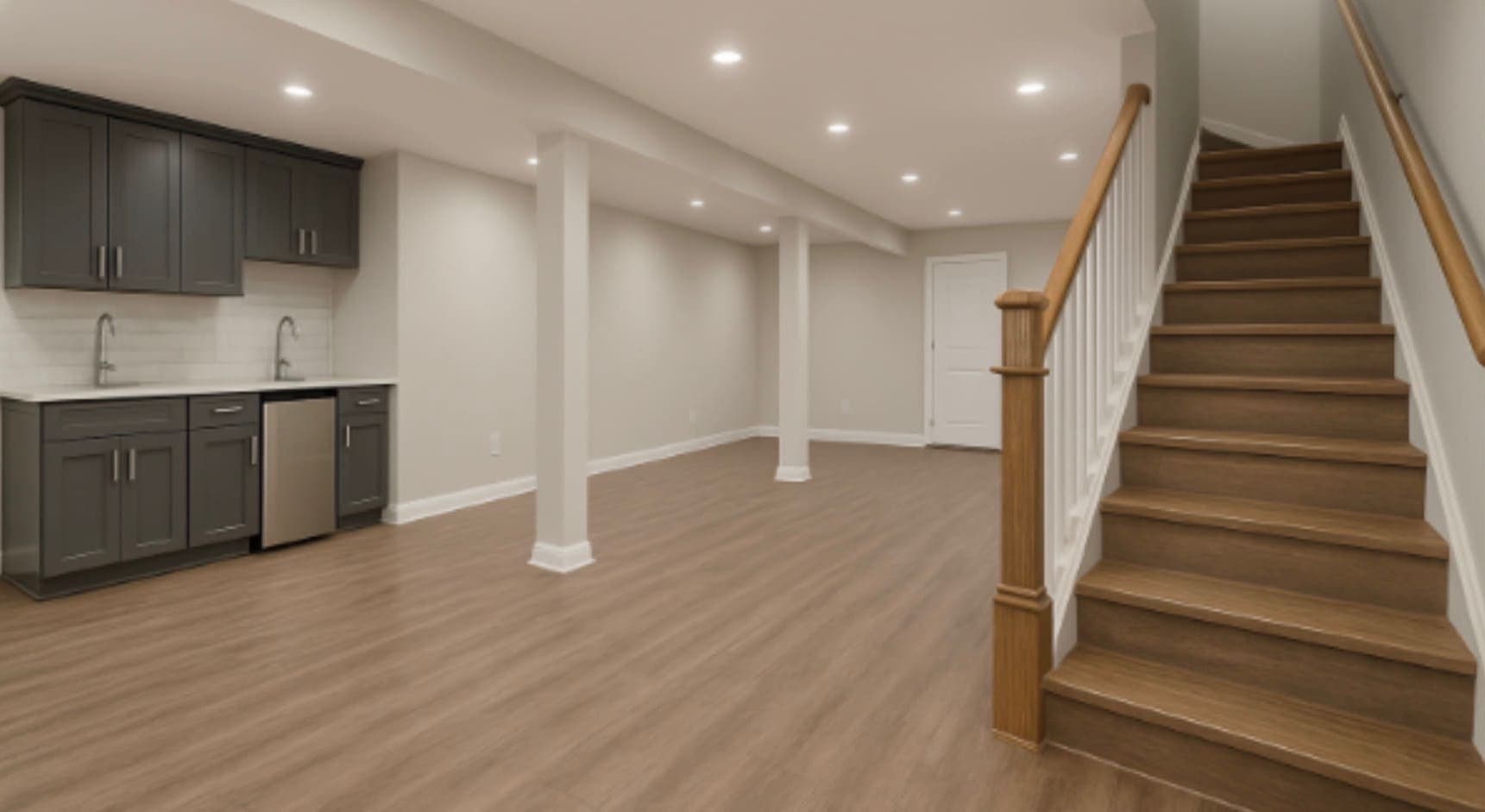
So the move is sequencing. If a basement is getting finished, the floor above gets walked, marked and screwed down before that ceiling closes — a short job with the joists in plain sight, a far worse one afterwards. It is the same visit where ducts and beams set the ceiling, and everything in those bays gets hard to reach at the same moment.
We publish no prices of our own, for the reason we give everywhere on this site: a number written before anyone has stood in the room is a guess. Published Indianapolis basement finishing research, including Angi, puts a finished basement at roughly $25–$65 per square foot — about $25,000–$65,000 for a 1,000 square foot basement.
Silencing the floor above is a rounding error inside a number like that, and only while the joists are open. One of several reasons the basement work gets scoped from the structure outward rather than the finishes back.
From above, when there is no below
A slab, a finished ceiling, a second story over living space — sometimes there is no underside to work from. The repairs get more compromised.
Through carpet. A jig-and-screw system drives a scored screw through carpet and pad into the joist, then snaps it off below the pile. It works, and it is nearly invisible. It depends entirely on hitting the joist — miss, and you have put a screw through your deck into nothing.
Through hardwood. A finish nail or trim screw driven at an angle into the joist, set below the surface and filled, with pairs at opposing angles holding better than one straight fastener. Be honest about the result. A filled hole is visible in raking light for as long as the floor exists, and if the cause is a joist that shrank away from the deck, a fastener through the flooring never closes that gap.
Lubricants. Talc, graphite or a dry powdered lubricant worked into the seam between boards quiets a tongue-in-groove squeak by stopping wood gripping wood. Useful for a finish-floor noise, useless for anything structural, and it works its way out. Maintenance, not repair.
What does not work
- Refinishing. Sanding and coating changes a surface and fastens nothing — one of the things a refinish will not correct.
- New flooring over a squeaky deck. It hides the noise for a season, then reports it back through the new product — and now the repair means taking up something you just paid for.
- Adhesive squirted at the general area. It works in a gap that has been identified and cleaned. Sprayed into a bay from a ladder it is a mess with a receipt.
- More nails. Fresh nails through the finish floor add fasteners to the layer that was not the problem.
Stairs squeak for their own reasons
A staircase is treads, risers and stringers, wedged and glued from behind. The noise is a wedge that loosened, a glue block that let go, or a tread never fastened to the riser under it. With the underside open, re-wedging and re-gluing shows nothing from the front. Closed in, you are face fastening again. It matters most when carpet comes off, because every noise gets louder without a pad over it — part of what is under stair carpet.
When a squeak means something worse
Most squeaks are cosmetic. These are not:
- Give underfoot, or a spongy patch, at a bathroom door, beside a tub or around a toilet. That reads as a wet subfloor, not a loose one.
- A new noise that arrived with a stain on the ceiling below.
- A squeak with a visible slope, a door that started sticking, or drywall cracking above. That is the structure moving, and fastening the floor over it treats a symptom.
We would rather tell you a floor needs looking at from underneath than sell you a repair that makes a structural problem quieter.
The cheapest time is when the floor is already open
Any remodel that takes flooring up buys the chance to fix this for almost nothing. With the deck exposed, the field gets walked, loose areas get screwed to the joists on a grid, seams get blocked, and adhesive goes where it should have gone the first time — the same pass that gets the deck flat. It is one more reason flooring is a room-by-room decision rather than a product choice, and why floor repair left off a scope is a familiar route to a change order.
The short version
The flooring is not squeaking. Something under it is moving, and the noise is the report. Work out whether it is a fastener, a gap over a joist, or the finish floor rubbing itself. Then fix it from below if you can get below, in winter if you can wait, and before a basement ceiling closes. From above always costs you something visible.
If there is a spot in your house you have started stepping around, or you are finishing a basement under one, ask for an estimate and we will get underneath it with you. Rooms taken back to the deck and put together again are on our projects.