Take the cover off a floor register and look at the cut ends of the boards inside the duct boot. That sawn section is the whole decision. Not the scratches in the hallway, not the dog, not the year the house was built. How much wood sits above the tongue settles whether a floor can be sanded again, and you can see it with a torch and a screwdriver.
The finish is what you look at, and the finish is meant to wear out. It is the sacrificial layer. The wood under it is usually sound. What ends a hardwood floor is rarely foot traffic — it is sanding history, water, and somebody's decision to fill a joint that was still moving.
The only measurement that settles it
A solid strip floor is a board with a tongue milled on one edge and a groove on the other, blind-nailed at an angle through the tongue. Everything above that tongue is wear layer: wood you are allowed to remove. Everything at or below it is structure. Sand into the tongue and you expose cleats, boards work loose, and the edges break away under the next machine that touches them.
So the question at a register cut is short. Where is the tongue, and how much clean wood sits above it?
A floor sanded once has less than a floor never sanded, and how much less depends entirely on who did it. An aggressive first cut with a drum, chasing out deep scratches, takes real thickness. A screen-and-recoat — abrading the old coating and putting fresh finish over it — takes almost none. Two owners will both tell you the floor "was refinished" and mean completely different things.
Where to look without pulling up a board
- A floor register. The best window you have.
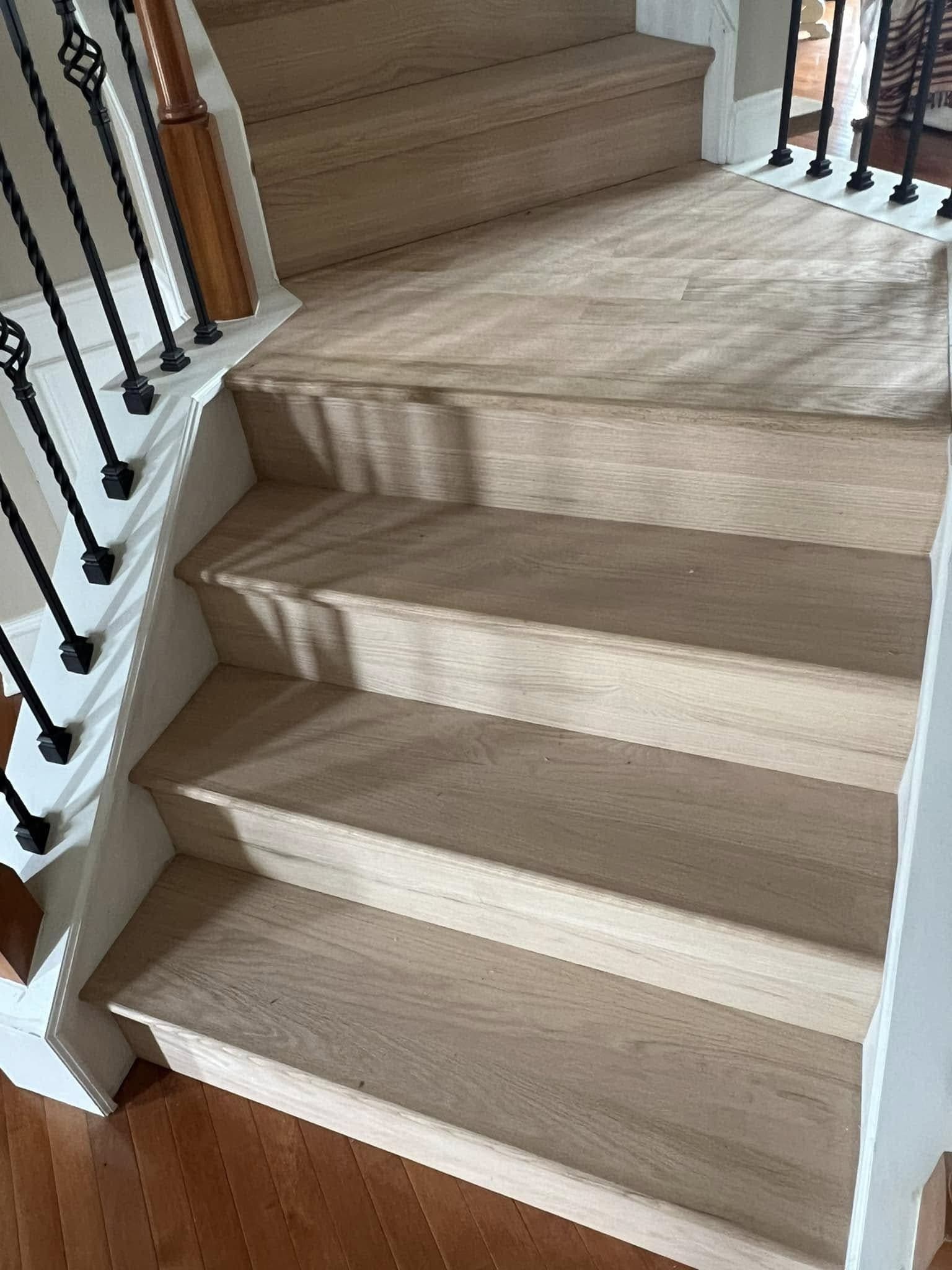
- A stair nosing or a doorway threshold. Both show an edge in section rather than in plan.
- Inside a closet or under the refrigerator. Not thickness, but the original color and sheen before the room wore it down. Worth seeing before anyone talks you into a stain.
The tells that a floor has already been through a drum
Get low and let light rake across the boards from the side. A sanded floor usually says so:
- Nail heads at the surface, especially in the perimeter band where an edger cut down to a fastener.
- Bevels gone. Older strip flooring carried a slight bevel at the board edge. Sanded flat, the joints read as hairlines instead.
- Chatter. Fine regular ripples across the grain, like corduroy, left by a drum that was not set up right.
- Dish-out around knots and in doorways, where softer wood gave up faster than the wood beside it.
None of that condemns a floor by itself. Put it beside a thin section at the register and you have the picture.
What sanding corrects, and what it does not
Refinishing is more aggressive than people expect, and narrower.
What comes back
Surface scratches, scuffed traffic lanes, cloudy finish and the gray that sets in where the coating has gone entirely — all of it lives in the finish or the top sliver of wood, and all of it goes. Color changes: red oak ambered under an old oil finish comes back much lighter, or goes much darker. Sheen changes, which alters a room more than people predict, because satin hides what gloss advertises. Isolated damage sands out. Mild cupping flattens, but only once the floor has come back to a stable moisture content and stayed there.
What stays
- Pet urine. The black staining is not on the wood, it is in it, and usually into the subfloor as well. Sanding lightens the halo and leaves the core. The honest fix is cutting those boards out.
- Gaps between boards. That is the floor breathing. Fill them in winter and the wood swells against the filler in summer, crushes its own edges, and gaps worse the following winter than it did before.
- Crushed fiber. A dent is compressed wood, not missing wood. A gouge sands out; a dent under a piano leg largely does not.
- A floor that is not flat. A sander rides the plane it is given. Humps, dips and a bounce between joists stay exactly where they are, which is why flatness is a subfloor question and not a finishing one.
- Squeaks. They come from movement between flooring, subfloor and joist. Finish fastens nothing.
- Water damage with a live source behind it. Sanding a cupped floor while the leak still runs is money set on fire.
Engineered floors change the question entirely
Engineered flooring is a wear layer of real wood over a plywood or composite core, and everything else follows from how thick that top layer is. A thick sawn-veneer board can take a full sanding and sometimes more. A thin rotary-peeled veneer takes a light screen and nothing else — put a drum on it and you go through to the ply, which cannot be fixed, only replaced.
Tell them apart at an exposed edge. The laminations stack like a sandwich, and the top slice is your whole budget. If it is barely a shaving, the floor gets recoated rather than sanded, and replaced when that stops working.
Prefinished boards, solid or engineered, carry a problem of their own: the factory micro-bevel at every edge does not disappear until the whole floor has been sanded flat, which is thickness spent before any finishing starts.
Season, moisture, and the month you sand
Wood here does not sit still. Humid summers push moisture into the boards and heating season pulls it back out, so a floor is wider in late summer and narrower in the depths of winter. That is not damage, it is what wood does in this climate, and it drives two practical rules.
First, judge a floor in the season you are standing in and expect the opposite when the weather turns. Winter gaps are normal. Summer cupping across the width of the boards usually means moisture is arriving from below — a crawl space, a slab, an unconditioned basement — and that is a moisture problem to solve before it is a floor problem to sand.
Second, finish when the house is at normal conditions, with the HVAC running as it runs the rest of the year. A floor finished in an empty house with the heat off is finished at a moisture content it will not keep.
Around Fishers, Carmel and Noblesville we find original strip oak under carpet more often than people expect, along with the reason it was carpeted — a patched heat run, a scar where a wall came out. What is behind the walls of an older house here tends to be under the floors too.
Where solid hardwood does not belong
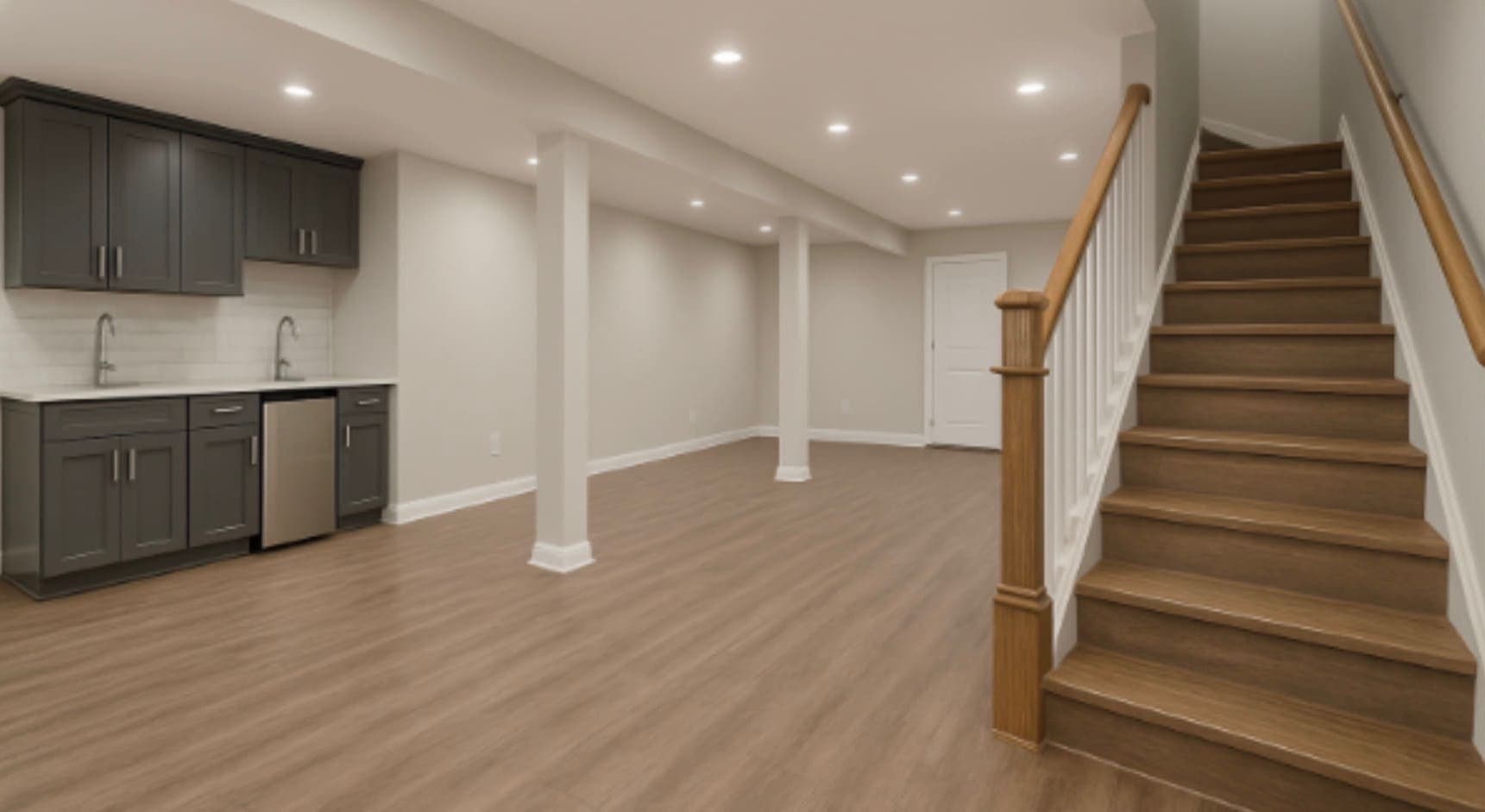
Below grade is the clear one. A slab drives vapor upward year-round, and solid hardwood nailed or glued to it will cup, crown and come apart no matter how dry the room feels the day it goes down. For wood underfoot in a finished basement, the answer is an engineered or resilient product over the assembly that actually survives concrete. Flooring is one reason the basement page starts at the slab and not at the finishes.
Full bathrooms and laundry rooms are the other. Not because wood cannot handle humidity — it can — but because it cannot handle water standing in a joint that gets walked on wet every morning. Flooring is a room-by-room decision, not a whole-house one.
The kitchen question: does the floor run under the cabinets?
Pull the dishwasher out and look at the floor beneath it. If the hardwood runs continuously under the cabinets, a layout change is straightforward and the whole floor sands afterward as one plane. If it stops at the toe kick — laid after the cabinets went in — then moving a run, deleting a peninsula or widening an opening leaves a bare channel of subfloor to be laced in with matching material.
Lacing is real work and a line most quotes leave out. Boards get cut back in a staggered pattern so the repair does not read as a rectangle, new material gets woven in, and the whole floor is sanded so patch and original read as one plane. Species and cut have to match — quarter-sawn white oak laced into plain-sawn red oak stays visible forever. When the sink or the range moves, the floor moves with it, which is why flooring belongs in the same conversation as the cabinets on the kitchen page rather than at the end of it.
Sequence matters too. Floors get sanded after the dusty trades and before the last coat on the walls, with the shoe molding off first and back on after — one more reason trim gets planned, not improvised.
Between the two answers
Refinish and replace are not the only options on the table.
- Screen and recoat. If the finish is worn but not breached to bare wood, abrading and recoating restores the surface without spending any wear layer. The cheapest useful thing you can do to a floor, and offered far less often than it applies.
- Repair and refinish. Cut out the ruined boards, lace in new ones, sand the whole floor as one. The answer for pet damage in a corner.
- One area at a time. A run that carries from the kitchen through the hall cannot be stopped mid-room. A doorway with a threshold can.
When replacement is the honest answer
A short list, and every item on it is something you can look at rather than something you have to take on faith:
- No wear layer left. The register cut shows finish, a shaving of wood and then the tongue. Another pass takes the fasteners with it.
- Veneer too thin to cut. An engineered board whose top slice reads as a hair at the exposed edge is a recoat candidate at best.
- Damage that runs through the boards rather than across them. Urine soaked through a whole room, rot under a leak that ran for a season, char or smoke driven into the grain — none of that is a surface problem.
- Nothing to lace with. If species, cut and width cannot be matched, every repair stays a visible patch, and the patches are what the eye goes to.
- The wrong floor for the room. Solid wood on a slab, or in a room that takes standing water, does not improve with sanding. It needs a different assembly, not a different finish.
None of those are close calls. Almost everything short of them is, which is why the register cover comes off before anyone quotes anything.
Site-finished or prefinished, if you replace
Site-finished means raw boards installed, then sanded and finished in place: a flat continuous surface with no bevels, any color you want, and a floor that can be patched invisibly later. It also means dust, finish odor and rooms out of use while coats cure, which is one of the harder parts of living in the house while work happens.
Prefinished means factory-cured finish on every board, installed and walked on. Tougher coating, no fumes, sooner back in use, but permanent micro-bevels and a patch that never disappears. Neither is better. They fail differently.
Where a floor sits in the budget
We publish no prices of our own, for the reason we give everywhere: a number written before anyone has stood in the room is a guess. What can be pointed at is independent research on this market. Angi, Homeyou and Block Renovation research puts an Indianapolis kitchen project at roughly $18,000–$24,000, with the full spread running about $8,000–$40,000.
Read that as the shape of a whole room, not a flooring line. Flooring is a modest share of a project like that and an outsized share of how finished the result reads. Which is why it belongs on an itemized estimate as its own set of lines — prep, repair, sanding, finish, transitions, shoe — not one word with a number beside it.
The short version
Find an exposed edge and look at how much wood sits above the tongue. Check whether the floor has been sanded before. Then separate what a machine can fix from what it cannot: color, wear and light cupping come back; urine staining, gaps, crushed fiber and an unflat subfloor do not. If the floor is engineered, veneer thickness answers the question before anything else does.
Most of the floors we look at get sanded rather than torn out. Some need a recoat and nothing more, which is the cheapest good news in this trade. A few are genuinely spent, and saying so out loud is easier than pretending otherwise.
If you want someone to lift the register and tell you which one you have, ask for an estimate. We look, then quote.